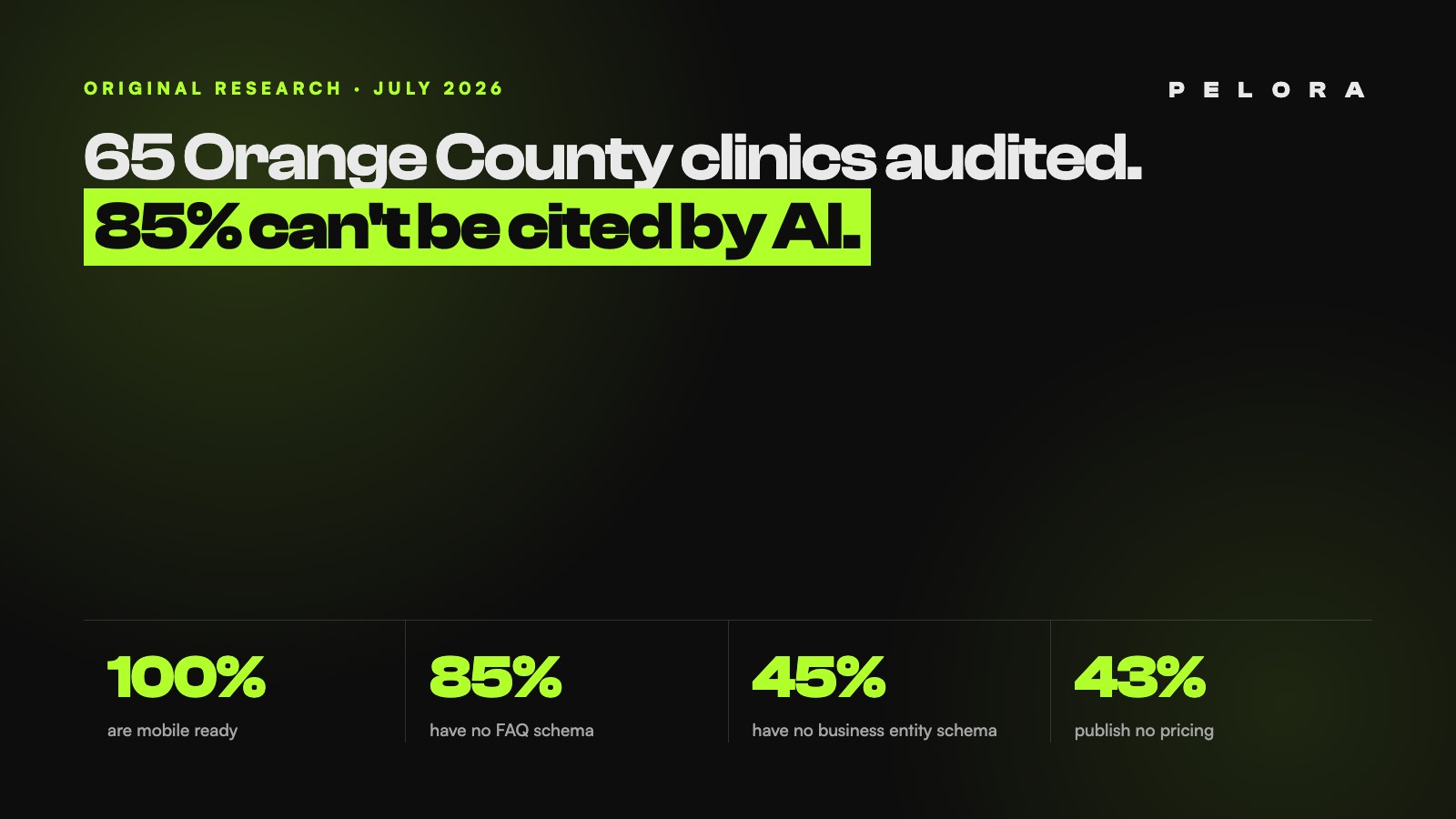
We audited 65 live Orange County health and wellness websites. 100% are mobile ready, the median homepage is 270 KB and loads in 0.88 seconds, and not one is over 3 MB. But 85% carry no FAQ markup, 45% carry no business entity markup, and 66% have neither. These businesses built for the last era of search and have not yet built for the one where customers ask a question and get one answer.
What we measured, and what we refused to measure
Most agency "studies" are opinion with a percentage sign attached. We wanted the opposite, so every figure here comes from a fact a machine can check.
We loaded each business's live homepage once and recorded whether it carried LocalBusiness or medical schema, whether it carried FAQPage schema, whether there was a tap-to-call telephone link, whether online booking was reachable from the homepage, whether any pricing appeared, and then page weight, load time, mobile viewport tag, and meta description.
We deliberately did not score design, brand, copywriting, or anything else a reasonable person could argue about. There is no beauty contest in this report. Every number is reproducible by anyone willing to fetch the same pages.
Methodology
- Sample drawn from four Orange County roundups PELORA researched and published earlier in 2026, covering med spas, medical weight loss and GLP-1 programs, men's health and TRT clinics, and concierge nursing companies. Each business had already been verified as real and operating.
- One PELORA client appeared in the original set and was removed before any figure was calculated, so this sample is independent of our own work.
- 68 businesses were attempted. 3 did not respond to an automated request and are excluded rather than counted as failures, giving a final sample of 65.
- Homepage only, one request each, July 2026. A clinic may offer booking, pricing, or an FAQ on an inner page we did not fetch, so read those three figures as "reachable from the homepage".
- Structured data was detected by parsing JSON-LD in the delivered HTML. Markup added later by a client-side script would not be counted, which is itself a visibility problem, since crawlers that do not execute scripts see what we saw.
The finding that surprised us: these are not bad websites
We expected to find slow, broken, unresponsive sites. We did not find them. Every site we reached carried a mobile viewport tag. The median homepage was 270 KB and finished in 0.88 seconds. Not a single one exceeded 3 MB, and only 11% took longer than three seconds.
That matters because it kills the easy explanation. You cannot look at this group and say they are behind on the web. They are not. Somebody built these sites competently, for mobile, and made them fast.
What almost none of them did was make the information on those fast mobile pages legible to a machine that is trying to answer a question on their behalf.
Where they are actually invisible: structure for AI
55 of 65 sites, 85%, carry no FAQ markup at all. FAQPage schema is how you hand a system a question and its answer as a matched, quotable pair. Without it, an answer engine has to infer what on your page constitutes an answer, and it will usually prefer a competitor who did not make it guess.
45% carry no LocalBusiness or medical entity markup, the code that states plainly what type of business this is, which city it serves, and how to contact it. 12% carry no structured data whatsoever.
66% are missing both. That group is the one with the hardest road ahead, because when a prospective patient asks an assistant for the best option near them, these businesses have supplied almost nothing an assistant can safely repeat.
The conversion gaps behind the visibility gap
43% published no pricing of any kind. In a category where the first real question is almost always what it costs, that sends people back to search to find someone who will tell them, and increasingly the thing that answers instead is an AI summary built from whoever did publish.
31% gave no way to book or schedule from the homepage. Only 9% were missing a tap-to-call link, so the phone is mostly covered. It is self-service booking, the thing a lot of people now prefer over calling, that is missing.
Counting only the four that decide whether a visitor can act and whether a machine can identify you, homepage booking, tap-to-call, entity markup, and published pricing, 40% of the businesses we audited failed two or more.
How the four categories compare
| Category | Sites | No FAQ schema | No entity schema | No homepage booking | No pricing |
|---|---|---|---|---|---|
| Med spa / aesthetics | 19 | 95% | 42% | 11% | 37% |
| Medical weight loss / GLP-1 | 22 | 77% | 36% | 27% | 41% |
| Men's health / TRT | 17 | 88% | 47% | 41% | 47% |
| Concierge nursing (small sample) | 7 | 71% | 71% | 71% | 57% |
Med spas are the most competitive category and the most booking-ready, with only 11% missing homepage booking, yet 95% still have no FAQ markup. Men's health and TRT clinics are the weakest on booking at 41%. The concierge nursing figures come from only 7 businesses and should be treated as directional, not conclusive.
Why this is happening, and why it will not fix itself
Every one of these businesses invested in a mobile-friendly, fast website, because that was the advice for a decade and it was correct advice. Structured data never felt urgent, because for years the cost of skipping it was a slightly less rich search listing.
That cost changed. When a person asked Google a question, they got ten links and picked one, and your unmarked page still had a chance. When a person asks an assistant, they get one answer assembled from sources the system felt confident quoting. Markup is a large part of how that confidence gets earned.
The businesses in the 66% are not going to notice this the way they noticed mobile. Nobody complains that your site looks broken. The traffic simply never arrives, and it is very hard to miss something that never showed up.
What we would fix first
If you run one of these businesses, the order matters more than the effort. Add LocalBusiness or medical schema so a machine can state what you are and where you operate. Put the questions your patients genuinely ask on the page, answer them in plain language, and mark them up with FAQPage schema. Make booking reachable in one tap from the homepage. Publish at least a starting price.
The first two are usually a few hours for a competent developer, and they are the two that determine whether an AI answer can cite you at all. That is the whole reason AI search optimization is now a distinct discipline from the content marketing that used to be enough.
The uncomfortable part of this data is how cheap the fix is. Nobody in the 85% is losing to a bigger budget. They are losing to markup.
Want to know how your site scored?
If your business is in this study, we ran these same checks on your homepage and we will send you your results, free, whether or not you ever hire us. If you are not in it, we will run the same audit on your site. Same checks, same standard, no pitch attached.
Get my results Call (760) 409-7544FAQQuestions about this study
What did this study measure?
We loaded the live homepage of 65 real Orange County health and wellness businesses and recorded objective, machine-checkable facts: whether the page carried LocalBusiness or medical schema, whether it carried FAQPage schema, whether a tap-to-call telephone link existed, whether online booking or scheduling was reachable from the homepage, whether any pricing appeared, plus page weight, load time, mobile viewport, and meta description. We did not score design, copy quality, or anything subjective.
Why does FAQ schema matter for AI search?
FAQPage schema marks a question and its answer as a discrete, quotable pair. It is one of the clearest signals an answer engine can use to lift a specific answer off your page and attribute it to you. 55 of the 65 sites we reached (85%) had none. Those businesses can still rank in a traditional search result, but they have given AI systems very little that is structured enough to quote.
Are these bad websites?
No, and that is the most interesting part. Every single site we reached, 100% of them, carried a mobile viewport tag. The median homepage was 270 KB and finished loading in 0.88 seconds. Not one exceeded 3 MB. This group solved mobile and solved speed. What most of them have not done is make their information legible to the systems people now ask questions to.
What is the single most common gap?
Structure for AI, by a wide margin. 85% lacked FAQ schema and 45% lacked LocalBusiness or medical entity schema, which is the markup that tells a machine what kind of business this is, where it operates, and how to reach it. Behind that, 43% published no pricing of any kind and 31% offered no way to book from the homepage.
How were the businesses chosen?
They came from four Orange County roundups PELORA researched and published earlier in 2026, covering med spas, medical weight loss and GLP-1 programs, men's health and TRT clinics, and concierge nursing companies. Each business had already been verified as real and operating by loading its website. None is a PELORA client. One business in the original set is a PELORA client and was removed from this sample before any figure was calculated.
What are the limits of this study?
Three, stated plainly. First, this is a homepage audit, not a full-site crawl, so a clinic may well offer booking or an FAQ on an inner page we did not fetch; every booking and pricing figure should be read as 'reachable from the homepage'. Second, 3 of the 68 sites we attempted did not respond to an automated request and are excluded, so the sample is 65. Third, the concierge nursing group is only 7 businesses, which is too small to generalize from, and we have labelled it as such rather than dropping it.
What should a clinic owner do about this?
In order: add LocalBusiness or medical entity schema so machines can identify you, put your real questions and answers on the page and mark them up with FAQPage schema, make booking reachable in one tap from the homepage, and publish at least a starting price. The first two are usually a few hours of work for a developer and they are the two that decide whether an AI answer can cite you at all.
Citation: PELORA Marketing, Orange County Health and Wellness Website AI Visibility Report, July 2026. Based on an audit of 65 live Orange County business homepages. Journalists and researchers are welcome to cite these figures with a link to this page. Contact Preston Durnford at (760) 409-7544 for the methodology or the underlying check list.