Which agencies rank highest, and who is each for?
These are the four highest-ranked agencies and the buyer each suits best.
Each agency was read on its own site on 10 and 11 October 2026. Nine of the thirteen say nothing about any of the three rule sets.
How do the thirteen agencies compare?
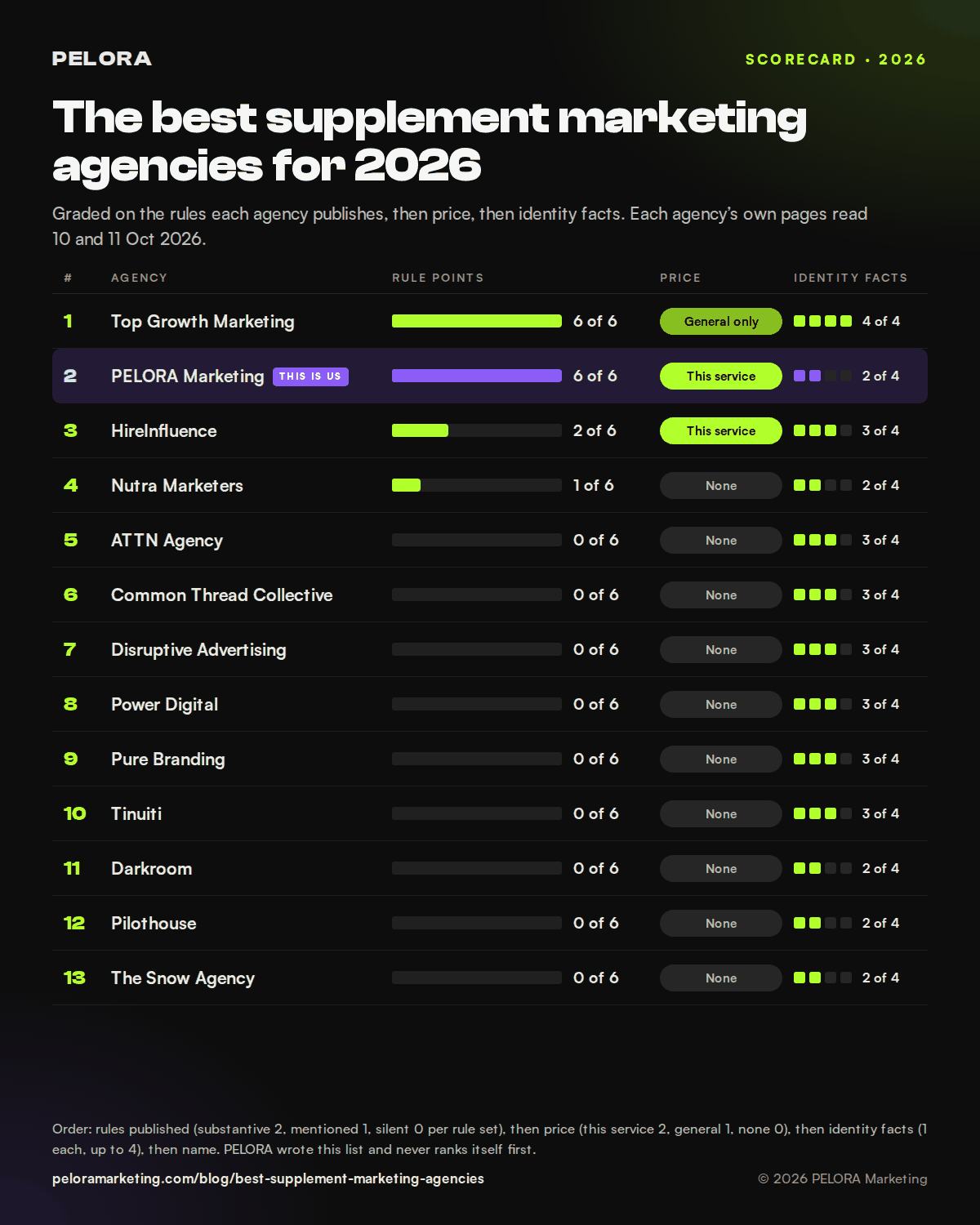
Every agency, graded on the rules it publishes, its price and its identity facts, in published order. Sort any column to re-rank.
| Rank and agency | Best for | FDA claim rules (DSHEA) | FTC evidence and endorsement rules | Meta and Google supplement rules | Rule points | Price | Identity facts | Read on |
|---|---|---|---|---|---|---|---|---|
| 1 Top Growth Marketing Los Angeles, CA | Shopify brands doing $100K to $25M a year | Substantive | Substantive | Substantive | 6 of 6 | General: $3,500+ range | 4 of 4 | 10 to 11 Oct |
| 2 PELORA Marketing Newport Beach, CA This is us | Every ad and creator post checked first | Substantive | Substantive | Substantive | 6 of 6 | On our page | 2 of 4 | 11 Oct |
| 3 HireInfluence Austin, TX | Enterprise creator campaigns, FTC disclosure built in | Silent | Substantive | Silent | 2 of 6 | About $100,000 minimum | 3 of 4 | 10 to 11 Oct |
| 4 Nutra Marketers Not published | New brands needing launch and label help | Mentioned | Silent | Silent | 1 of 6 | Not published | 2 of 4 | 10 to 11 Oct |
| 5 ATTN Agency San Diego, CA | Paid social, retention and direct mail | Silent | Silent | Silent | 0 of 6 | Not published | 3 of 4 | 10 to 11 Oct |
| 6 Common Thread Collective Costa Mesa, CA | Growth planned around contribution margin | Silent | Silent | Silent | 0 of 6 | Not published | 3 of 4 | 10 to 11 Oct |
| 7 Disruptive Advertising Pleasant Grove, UT | Buyers who weight third-party reviews most | Silent | Silent | Silent | 0 of 6 | Not published | 3 of 4 | 10 to 11 Oct |
| 8 Power Digital San Diego, CA | Larger brands wanting it all under one roof | Silent | Silent | Silent | 0 of 6 | Not published | 3 of 4 | 10 to 11 Oct |
| 9 Pure Branding Leverett, MA | Brand strategy and research before ads | Silent | Silent | Silent | 0 of 6 | Not published | 3 of 4 | 10 to 11 Oct |
| 10 Tinuiti New York, NY | Enterprise Amazon and retail media | Silent | Silent | Silent | 0 of 6 | Not published | 3 of 4 | 10 to 11 Oct |
| 11 Darkroom New York, NY | Brands above $10M a year | Silent | Silent | Silent | 0 of 6 | Not published | 2 of 4 | 10 to 11 Oct |
| 12 Pilothouse Victoria, BC | Named case studies and heavy creative | Silent | Silent | Silent | 0 of 6 | Not published | 2 of 4 | 10 to 11 Oct |
| 13 The Snow Agency (Avenue Z) New York, NY | TikTok Shop and paid social creative | Silent | Silent | Silent | 0 of 6 | Not published | 2 of 4 | 10 to 11 Oct |
Tap any column heading to sort; ties keep the published order. On a phone, swipe the table sideways to see every column.
Who writes the supplement claim rules down?
Two of the thirteen state all three.
Of the thirteen firms here, including us, two state the FDA, FTC and platform rules: Top Growth Marketing, on its own ranking, and PELORA, on a dedicated rules page. One more, HireInfluence, states the FTC disclosure and claims rule for creators, and Nutra Marketers names the FDA without saying what it restricts. Nine say nothing about any of the three, including firms with supplement brands on their home pages. And two publish a price for this work: PELORA and HireInfluence; Top Growth Marketing lists a general price range.
That gap is the one that costs money. A disease claim in an ad is a drug claim to the FDA, an unsubstantiated claim to the FTC, and a disapproval to Google, and the agency writing the ad is the one deciding which words go in.
- This service: PELORA Marketing, HireInfluence
- General only: Top Growth Marketing
- None: Nutra Marketers, ATTN Agency, Common Thread Collective, Disruptive Advertising, Power Digital, Pure Branding, Tinuiti, Darkroom, Pilothouse, The Snow Agency
Swipe sideways for all three charts. The scorecard table above holds every value.
Which rules decide a supplement brand’s ads?
Three: the FDA’s structure/function rules, the FTC’s evidence standard, and Meta and Google’s supplement policies.
A supplement brand’s ads answer to a regulator for the claim, a second regulator for the evidence and the endorsement, and two platforms for everything else. We graded every firm on what it publishes about each. “Silent” means does not publish on the pages we read, not does not know. All four sources were read on 11 October 2026.
FDA, under DSHEA
A supplement may claim how it supports the body’s normal structure or function, never that it treats or prevents a disease.
Source: FDA, Structure/Function Claims, read 11 Oct 2026.
Read the rule, quoted
A supplement may make structure/function claims, which
“may describe the role of a nutrient or dietary ingredient intended to affect the normal structure or function of the human body, for example, ‘calcium builds strong bones.’”
The maker “must submit a notification with the text of the claim to FDA no later than 30 days after marketing”, and the label disclaimer must say the product is not intended to “diagnose, treat, cure or prevent any disease,” “because only a drug can legally make such a claim.” An ad that crosses that line is selling a drug.
The FTC
Health benefit claims need competent and reliable scientific evidence, usually randomized, controlled human trials, and a creator’s post is the brand’s claim.
Source: FTC, Health Products Compliance Guidance, read 11 Oct 2026.
Read the rule, quoted
Its Health Products Compliance Guidance says health benefit and safety claims “require substantiation in the form of competent and reliable scientific evidence”, and it describes randomized, controlled human clinical testing as the evidence health benefit claims will usually need. The same guidance applies to endorsements: a creator’s post is the brand’s claim.
Meta and Google
Meta requires supplement ads to target people 18 or older; Google bars products implied to work like prescription drugs or to treat a disease.
Sources: Meta Transparency Center, Health and Wellness and Google Ads, healthcare and medicines, read 11 Oct 2026.
Read the rule, quoted
Meta says ads for dietary or health supplements “must be targeted to people at least 18 years or older”, and it bars claims to cure, heal or eliminate a listed set of diseases. Google’s healthcare policy does not allow, among others:
“Products that imply they’re as effective as prescription drugs or controlled substances” and “Non-government approved products that are marketed in a way that implies that they’re safe or effective for use in preventing, curing, or treating a particular disease or ailment”
Our supplement ad claims research sorts real claims against these lines.
Swipe sideways for all three rule tiles.
How did we build this list?
We read each firm’s own pages on 10 and 11 October 2026, graded only what is there, and ordered the list by a fixed rule.
What we did not grade: results we cannot audit, and Clutch ratings, which we report but do not score. Every number a firm reports about itself is labeled per agency. PELORA is scored by the same rule from its own pages, with company facts taken only from our own home and about pages.
The full method, rubric and read log
We started from five competing “best supplement agency” lists, the firms that surface for the searches a supplement founder would run, and the names that recur across them: sixteen names, plus us. We read each firm’s own pages on 10 October 2026, re-read them on 11 October, and graded only what is there. Two were considered and not scored: MuteSix (its home page shows named case studies but no location, founding year, price or wellness detail; read 10 and 11 Oct 2026) and Cool Nerds Marketing (its supplement page names no supplement client; read 10 and 11 Oct 2026). Two more on competing lists, Body Science Marketing and Forge Digital, were not read for this edition. Twelve remained.
The order is a rule, not a judgment, and it is the same rule we use on every list:
- Rules published. For the FDA, the FTC and the ad platforms: substantive (it states the rule or what it restricts) scores 2, mentioned (it names the rule or the risk without saying what is restricted) scores 1, silent scores 0.
- Price published. A price for this service scores 2, a general price 1, none 0.
- Identity facts. One point each for a location, a founding year, named leadership and a named client.
- Order. By rules, then price, then identity, then name. No scores out of 100: nobody can audit those.
Read log: every page and date
- 10 Oct 2026: each firm’s home, about or supplement page and its Clutch profile where one exists, kept as text.
- 11 Oct 2026: re-read of every firm’s page linked on its card; Top Growth Marketing’s supplement agency ranking read for its rule writing; each re-read searched for FDA, FTC, DSHEA, structure/function and substantiation wording.
- 11 Oct 2026: the FDA, FTC, Meta and Google sources quoted above, and PELORA’s own pages as live on 11 Oct 2026.
All thirteen agencies, ranked
1. Top Growth Marketing · Los Angeles, CA
Best for: Shopify brands doing $100K to $25M a yearPrice: General: $3,500+ rangeStates all three rule sets.
Best for a Shopify supplement brand doing $100K to $25M a year that wants paid social run with the claim rules in mind
Rules published: FDA claim rules (DSHEA): substantive · FTC evidence and endorsement rules: substantive · Meta and Google supplement rules: substantive
Pricing: General only: its site lists a $3,500+ price range in its structured data, and its FAQ says pricing is “a monthly retainer based on scope and ad spend” (read 11 Oct 2026). It works with brands doing “$100K to $25M+ in annual revenue”.
Services: Paid social and search, creative, email and SMS on Klaviyo, analytics; it lists supplement and wellness DTC growth as an industry.
What we verified: Los Angeles; its home page says “Founded 2011 by Jack Paxton” (Clutch says 2012, which showed 4.9 from 18 reviews, read 10 Oct). Its home page claims “$336M+” in ad spend managed, “$783M+” in client revenue and “218+” brands (per agency); named clients such as Cobra, Atlas Coffee and Joovv carry no figures. The rule writing is on its own supplement agency ranking: supplement ads must “comply with FDA/FTC guidelines (no ‘cure’ claims, structure-function only)”, “disclosure-violating creators trigger ad bans”, and “Don’t use before/after imagery for weight loss supplements on Meta.”
Where it may not fit: All of that writing sits on a ranking that places Top Growth Marketing first; and its home page says nothing about the rules. Its supplement results are aggregates, not named supplement brands with numbers.
What we checked: its home page (10 and 11 Oct 2026), its supplement agency ranking (11 Oct 2026) and its Clutch profile (10 Oct 2026).
This is us. PELORA Marketing wrote this list. We graded ourselves by the same rubric, from our own pages; the note at the top says why we sit second and not first. The rubric rewards publishing the rules, which is something we do, so a list written by us will lean our way on that axis; every grade is shown cell by cell so you can re-rank on price or on named results yourself. The facts about our company below are the ones on our home page and about page.
2. PELORA Marketing · Newport Beach, CAThis is us
Best for: Every ad and creator post checked firstPrice: published on our supplement marketing pageStates all three rule sets.
Best for a supplement brand that wants every ad and creator post checked against FDA, FTC, Meta and Google rules before it runs, with prices published
Rules published: FDA claim rules (DSHEA): substantive · FTC evidence and endorsement rules: substantive · Meta and Google supplement rules: substantive
Pricing: Published, for this service, on our supplement marketing page, with the full ladder on our pricing page. We do not restate the figures here.
Services: Meta, Google and TikTok ads, creator and product video, Amazon, landing pages, AI search, email and CRM.
What we verified: Based in Newport Beach, California, with founder Preston Durnford and a 5.0 Google rating, as our home page states. Our supplement ad rules page states the structure/function line (never “diagnose, treat, cure or prevent”), the 30-day FDA notification, the FTC’s expectation of randomized controlled trials for health benefit claims, Meta’s 18-plus rule for supplement ads and Google’s bans; our supplement ad claims research sorts real claims against them.
Where it may not fit: We publish no named supplement client and no supplement result on the pages linked here, and our founding year is not among the facts we used, so we score 2 of 4 on identity, below the agency ranked first. If you need retail media at enterprise scale, the larger firms below have published more of it.
What we checked: our own supplement ad rules page, supplement marketing page and pricing page, read 11 Oct 2026; company facts from our home page and about page.
3. HireInfluence · Austin, TX, Los Angeles and New York
Best for: Enterprise creator campaigns, FTC disclosure built inPrice: About $100,000 minimumStates FTC evidence rules; silent on FDA claim rules and Meta and Google supplement rules.
Best for an enterprise supplement brand with retail distribution that wants creator campaigns with FTC disclosure handled in the contract
Rules published: FDA claim rules (DSHEA): silent · FTC evidence and endorsement rules: substantive · Meta and Google supplement rules: silent
Pricing: Published, for this service: “The agency’s minimum engagement is approximately $100,000”, on its supplement page.
Services: Influencer and creator campaigns: strategy, casting, contracting, content review and measurement.
What we verified: Offices in Austin, Los Angeles and New York; founded 2011 (read 10 Oct). Its supplement page states the rule at creator level: “The content has to be compliant with FTC disclosure guidelines and avoid making prohibited health claims”, and “FTC compliance is built in, not bolted on”, with claims, disclosures and “restrictions on testimonial language” managed in contracting and content review. Named campaigns (per agency) are for Ricola and Grammarly.
Where it may not fit: Influencer only, a $100,000 minimum, no supplement case study with numbers, and nothing on the FDA or on Meta and Google ad rules.
What we checked: its supplement page, read 10 and 11 Oct 2026.
4. Nutra Marketers · city not published
Best for: New brands needing launch and label helpPrice: Not publishedMentions FDA claim rules; silent on FTC evidence rules and Meta and Google supplement rules.
Best for a new supplement brand that wants launch, label, Amazon and DTC help from a supplement-only shop
Rules published: FDA claim rules (DSHEA): mentioned · FTC evidence and endorsement rules: silent · Meta and Google supplement rules: silent
Pricing: Not published.
Services: Supplement brands only: product launch, branding, label and packaging, Amazon, SEO, DTC and email.
What we verified: Founder John Smiddy; claims “20+ years” of experience. Named launches (per agency): Paulina Fitness, $0 to $138K in monthly revenue in four months, and Superior Labs, to $60M+ in sales. It says “We stay ahead of FDA regulations and evolving laws, ensuring your brand remains compliant and protected.”
Where it may not fit: It names the FDA without saying what the rule restricts, and nothing on the FTC or the ad platforms; no address and no price.
What we checked: its home page, read 10 and 11 Oct 2026.
5. ATTN Agency · San Diego, CA
Best for: Paid social, retention and direct mailPrice: Not publishedSilent on all three rule sets.
Best for a growth-stage DTC brand that wants paid social, retention and direct mail from one team with named results
Rules published: FDA claim rules (DSHEA): silent · FTC evidence and endorsement rules: silent · Meta and Google supplement rules: silent
Pricing: Not published as a figure; no long-term contracts (per agency).
Services: Paid social and search, email and SMS, direct mail, creative strategy, Amazon and Walmart retail media, connected TV, attribution.
What we verified: San Diego; founded 2016 per Clutch, which showed 4.8 from 28 reviews (read 10 Oct). A Google Premier Partner per its site. Named results (per agency): Goose Creek “from 8-figure to 9-figure annual sales”, and on our 10 October read, Grüns, a supplement brand, from launch to a $500M valuation in 20 months.
Where it may not fit: Nothing on FDA, FTC or platform rules on the pages we read, even with a supplement client on its home page. No price.
What we checked: its home page, read 10 and 11 Oct 2026; Clutch profile read 10 Oct 2026.
6. Common Thread Collective · Costa Mesa, CA
Best for: Growth planned around contribution marginPrice: Not publishedSilent on all three rule sets.
Best for a profitable DTC brand that wants growth planned around contribution margin, not revenue
Rules published: FDA claim rules (DSHEA): silent · FTC evidence and endorsement rules: silent · Meta and Google supplement rules: silent
Pricing: Not published.
Services: Its “Prophit Engine” system: forecasting, Meta, Google and TikTok Shop, creative, incrementality testing; also a training membership.
What we verified: Costa Mesa in its footer (Clutch says Santa Ana); founded 2012 per Clutch, which showed 4.1 from 17 reviews (read 10 Oct). Claims “$3B in profitable growth” across clients (per agency); logos include Love Wellness and Theragun, with no per-brand figures.
Where it may not fit: Nothing on supplement claim rules; results are aggregates; the lowest Clutch rating among the DTC firms here.
What we checked: its home page, read 10 and 11 Oct 2026; Clutch profile read 10 Oct 2026.
7. Disruptive Advertising · Pleasant Grove, UT
Best for: Buyers who weight third-party reviews mostPrice: Not publishedSilent on all three rule sets.
Best for a brand that weights third-party reviews most and wants a large performance team
Rules published: FDA claim rules (DSHEA): silent · FTC evidence and endorsement rules: silent · Meta and Google supplement rules: silent
Pricing: Not published.
Services: Paid search, paid social, email and conversion work for ecommerce and lead-generation clients.
What we verified: Pleasant Grove, Utah; founded 2011 per Clutch, which showed 4.8 from 371 reviews, the largest review base on either of our consumer lists (read 10 Oct). Google Premier Partner and Klaviyo Master Elite per its about page on our 10 October read; ecommerce logos include Litter Robot and First Lite.
Where it may not fit: A generalist: no supplement work and no results with numbers on the pages we read, and nothing on claim rules.
What we checked: its about page, read 10 and 11 Oct 2026; Clutch profile read 10 Oct 2026.
8. Power Digital · San Diego, CA
Best for: Larger brands wanting it all under one roofPrice: Not publishedSilent on all three rule sets.
Best for a larger CPG or supplement brand that wants paid, SEO, influencer, PR and measurement under one roof
Rules published: FDA claim rules (DSHEA): silent · FTC evidence and endorsement rules: silent · Meta and Google supplement rules: silent
Pricing: Not published.
Services: Paid media, SEO and AI search, influencer, PR, Amazon and TikTok Shop, measurement and media mix modeling; it has CPG and healthcare divisions.
What we verified: San Diego, with offices in New York and Arlington, VA, per Clutch; founded 2012 per Clutch, which showed 4.8 from 66 reviews and 250 to 999 staff (read 10 Oct). Client logos on our 10 October read included Cymbiotika, a supplement brand, with no per-client figures.
Where it may not fit: A healthcare division, but no FDA, FTC or platform process published on the pages we read, and no price.
What we checked: its home page, read 10 and 11 Oct 2026; Clutch profile read 10 Oct 2026.
9. Pure Branding · Leverett, MA
Best for: Brand strategy and research before adsPrice: Not publishedSilent on all three rule sets.
Best for a science-led nutrition brand that needs brand strategy and research before it needs ads
Rules published: FDA claim rules (DSHEA): silent · FTC evidence and endorsement rules: silent · Meta and Google supplement rules: silent
Pricing: Not published.
Services: Brand strategy, consumer and practitioner research, rebrands and packaging for nutrition and supplement companies.
What we verified: Leverett, Massachusetts; working with brands “since 1999” (read 10 Oct). Named work (per agency): Gaia Herbs, a rebrand it credits with three times the sales, and Persona, a DTC rebrand ahead of its acquisition by Nestlé.
Where it may not fit: A brand strategy firm, not a performance media agency, and nothing on claim rules on the pages we read.
What we checked: its home page, read 10 and 11 Oct 2026.
10. Tinuiti · New York, NY
Best for: Enterprise Amazon and retail mediaPrice: Not publishedSilent on all three rule sets.
Best for an enterprise brand whose growth runs through Amazon, retail media and streaming TV
Rules published: FDA claim rules (DSHEA): silent · FTC evidence and endorsement rules: silent · Meta and Google supplement rules: silent
Pricing: Not published.
Services: Amazon and retail media, streaming TV, search, social, affiliate, influencer, conversion work.
What we verified: New York per Clutch; founded 2004 as Elite SEM; claims “$4B” in media under management (per agency). Its about page lists a Google Premier Partner award; a case study says Hourglass “Unlocks $1M in Global Expansion via AI Search” (per agency).
Where it may not fit: Enterprise-sized, one Clutch review on our 10 October read, little DTC supplement detail, and nothing on claim rules.
What we checked: its about page, read 10 and 11 Oct 2026; Clutch profile read 10 Oct 2026.
11. Darkroom · New York, NY
Best for: Brands above $10M a yearPrice: Not publishedSilent on all three rule sets.
Best for a brand above $10M a year that wants Amazon, retention and paid media run together
Rules published: FDA claim rules (DSHEA): silent · FTC evidence and endorsement rules: silent · Meta and Google supplement rules: silent
Pricing: Not published as a fee; its typical client does $10M to $500M a year and it calls itself a poor fit under about $5M (per agency, read 10 Oct).
Services: Paid media, creative, retention, Amazon, TikTok Shop, AI search, media mix modeling.
What we verified: New York listed as a hub. Named results (per agency): “Laundry Sauce grew Amazon net revenue 290%”, Everlane’s Amazon revenue up 123%; named clients include ProHealth and Olipop.
Where it may not fit: We could not confirm that the Darkroom profile on Clutch is the same company, so we counted no founding year. Nothing on claim rules.
What we checked: its home page, read 10 and 11 Oct 2026.
12. Pilothouse · Victoria, BC, Canada
Best for: Named case studies and heavy creativePrice: Not publishedSilent on all three rule sets.
Best for a DTC brand that wants the most named case studies with numbers and a heavy creative and UGC engine
Rules published: FDA claim rules (DSHEA): silent · FTC evidence and endorsement rules: silent · Meta and Google supplement rules: silent
Pricing: Not published as a figure: a custom retainer plus performance incentives (read 10 Oct).
Services: Meta, Google, TikTok, Amazon and YouTube media buying, UGC and creative production, email and SMS, conversion work, influencer, attribution.
What we verified: Victoria, British Columbia. Named results (per agency): “Hestan Boost Sales by 78%”, CorneaCare’s “3595%” revenue growth, and “Four Sigmatic to #2 Best-Selling Ground Coffee on Amazon”; also Benchmade. A Meta Business Partner per its site on our 10 October read.
Where it may not fit: Four Sigmatic is a functional mushroom brand, but the page describes no supplement claims work, and we found no Clutch profile and no price.
What we checked: its home page, read 10 and 11 Oct 2026.
13. The Snow Agency (Avenue Z) · New York, Miami and Orlando
Best for: TikTok Shop and paid social creativePrice: Not publishedSilent on all three rule sets.
Best for a wellness-adjacent DTC brand that wants TikTok Shop and paid social creative
Rules published: FDA claim rules (DSHEA): silent · FTC evidence and endorsement rules: silent · Meta and Google supplement rules: silent
Pricing: Not published.
Services: DTC performance media, paid social creative, TikTok Shop, affiliate, Shopify conversion work.
What we verified: Part of Avenue Z, with offices in New York, Miami and Orlando. Named result (per agency): “Kind Patches Hit 175% Growth in 90 Days”; on our 10 October read it also named Monat ($800K on TikTok Shop) and clients including Mosh and cocokind, and showed a Shopify Platinum Partner badge.
Where it may not fit: Thin public company detail (no founding year or named leaders on the page) and nothing on claim rules. Avenue Z also publishes a supplement agency list that lists itself first.
What we checked: its agency page, read 10 and 11 Oct 2026; Avenue Z’s supplement agency list, which lists “1. Avenue Z”, read 11 Oct 2026.
How should you choose one?
Ignore the rankings, including this one, and run four checks instead.
Ask them to draw the line.
Hand them three claims from your own ads and ask which are structure/function and which are disease claims. If they cannot answer on the call, they will not catch it in an ad.
Ask what evidence file sits behind each claim.
The FTC’s standard is “competent and reliable scientific evidence”; ask who on their side checks it, and who on yours signs it off.
Ask for the number first.
Two firms here publish one for this work. Ask the rest in the first email, and ask whether ad spend is separate.
Ask for results in contribution margin and repeat purchase, not ROAS alone.
A supplement brand lives on subscriptions; a first-order ROAS says little about whether the customer came back. And ask who owns the ad accounts, the Shopify store and the email list if you leave; our account ownership guide shows how to check.
Questions supplement founders ask
Two of the thirteen firms here publish a number for this work: HireInfluence sets a minimum engagement of about $100,000 for creator campaigns, and our own prices are on our supplement marketing page. Top Growth Marketing’s site lists a $3,500+ price range but says pricing depends on scope and ad spend. Darkroom publishes a fit band rather than a fee: clients doing $10M to $500M a year. The rest publish nothing; ask in the first email.
Can a supplement brand say its product helps with a disease in a Facebook or Google ad?No.
The FDA says only a drug can legally claim to “diagnose, treat, cure or prevent any disease”. Meta bars claims to cure, heal or eliminate a listed set of diseases and requires supplement ads to target people 18 or older. Google does not allow non-approved products marketed as safe or effective for “preventing, curing, or treating a particular disease or ailment”. A structure/function claim, backed by evidence, is the lane that is left. Read on 11 October 2026.
What is a structure/function claim?A claim that describes how a nutrient or ingredient affects the normal structure or function of the body; the FDA’s own example is “calcium builds strong bones.”
The maker must notify the FDA no later than 30 days after marketing the claim, carry the disclaimer, and hold evidence that the claim is truthful and not misleading.
What evidence does the FTC expect behind a supplement ad?Its Health Products Compliance Guidance says health benefit and safety claims “require substantiation in the form of competent and reliable scientific evidence”, and it describes randomized, controlled human clinical testing as what health benefit claims will usually need.
A creator’s testimonial does not lower the bar; the brand is responsible for it.
Do I need a supplement specialist or a DTC growth agency?It depends on where the risk sits.
A launch-stage brand that needs label, packaging and Amazon help fits a supplement-only shop such as Nutra Marketers. A brand scaling paid social and retention fits a DTC firm such as Top Growth Marketing, ATTN Agency or Pilothouse. Either way, ask the claim questions above, because nine of the thirteen publish nothing on them.
Why is PELORA on its own list?Because we market supplement brands, and hiding that would not remove the conflict.
We scored ourselves with the same rubric as everyone else, from our own pages. We never rank ourselves first on a list we publish, so we sit second, behind Top Growth Marketing. The rubric rewards publishing the rules, which we do, so weigh our position with that in mind.
How do I know these rankings are trustworthy?Assume they are not, including ours, and check the sourcing.
Every claim about another firm is quoted from its own pages with the date we read it, numbers a firm reports about itself are labeled per agency, and where something was not on the pages we read we say so. Of the five competing lists we read, every one written by an agency ranked its author first.
Where does each fact come from?
From the page linked beside it, read on the date shown there; all 20 sources on this page are listed here.
Show all 20 sources
Rules and regulators
- FDA, Structure/Function Claims, read 11 Oct 2026
- FTC, Health Products Compliance Guidance, read 11 Oct 2026
- Meta Transparency Center, Health and Wellness, read 11 Oct 2026
- Google Ads, healthcare and medicines, read 11 Oct 2026
Agency pages
- Top Growth Marketing: home page
- Top Growth Marketing: supplement agency ranking
- HireInfluence: supplement page
- Nutra Marketers: home page
- ATTN Agency: home page
- Common Thread Collective: home page
- Disruptive Advertising: about page
- Power Digital: home page
- Pure Branding: home page
- Tinuiti: about page
- Darkroom: home page
- Pilothouse: home page
- The Snow Agency (Avenue Z): agency page
- The Snow Agency (Avenue Z): supplement agency list
Other pages cited
- MuteSix: its home page
- Cool Nerds Marketing: its supplement page
Who wrote this list?
Preston Durnford, founder of PELORA Marketing, wrote this list.

Published and last updated October 12, 2026. How this list was checked: each agency’s own pages were read on 10 and 11 October 2026, every rule source was re-read on 11 October 2026, and the claims were re-checked against their sources in a second pass before publication.
Book a 15-minute call →