Keep the account. Run the ad.
Clinic ad accounts get disabled for one sentence. This page shows the five ways it happens, what Meta, Google, LegitScript and FDA actually require, with dates, and how we read every ad and every creator post before it goes live.
Health advertising compliance is the set of platform and regulator rules that decide whether a clinic's ad runs and whether the account survives: Meta's health and wellness standard, Google's healthcare policy, LegitScript certification where a category requires it, FDA and FTC rules on claims and disclosure, and HIPAA consent for anyone who appears. Most disabled accounts trace to one sentence.
Every rule on this page was checked against the platform or regulator that publishes it on 2 September 2026. Rules change; the dates are on each item.
Five ways it happens.
- Personal attributes. Copy that tells a viewer something about their body, health or age. "Tired all the time?" runs. "Hate your belly?" does not.
- Drug ads in disguise. A prescription product named in an ad, or a dose, or a result. Prescription weight loss needs Meta's written permission first.
- Age targeting. Weight loss, cosmetic procedures and supplements must target 18-plus on Meta. Miss it once and the ad set is rejected; repeat it and the account is.
- Certification missing. Addiction treatment and prescribing telemedicine need LegitScript before the platform will run the ad at all.
- The landing page. Lorem ipsum testimonials, fake review widgets, a claim on the page the ad did not make. Reviewers read the page, not just the ad.
What the platforms actually say.
Each item below is from the platform's or regulator's own published standard, checked on 2 September 2026. This is the read we run on every ad and every creator post before it goes live.
LegitScript, in plain numbers
| Healthcare certification | Addiction treatment certification | |
|---|---|---|
| Who needs it | Pharmacies, telemedicine that ends in a prescription, and other healthcare merchants. Google requires it for those advertisers in the US and Canada. | Addiction treatment providers. A named prerequisite on Google and Meta before ads run in the US. |
| What it costs | $975 application per website, then $2,150 a year. Expedited review, starting within two business days, is $2,500 more. Probationary certification, with more frequent monitoring, is $3,995 a year. | $1,395 to $1,595 per facility to apply, then $2,550 to $3,095 per facility a year, lower at higher facility counts. Individual practitioners: $535 to apply, then $1,070 a year. Expedited review is $2,500 more. |
| What you send | Business and professional licenses, registrations and DEA certificates, a HIPAA-compliant privacy policy, affiliate and partner details, product and service descriptions, ad materials. | The same file, plus licensing for each level of care you advertise. |
| Who recognizes it | Google, Meta, Microsoft Bing, LinkedIn, TikTok, Netflix, Nextdoor and Yahoo for ads; Visa and Mastercard for payments. | Google, Meta and Microsoft for ads. |
| What it does not do | Unlock stem cell or cell therapy ads on Google; that gate is FDA license or approval for the specific product. | Replace consent, 42 CFR Part 2 or EKRA. It gets the ad approved, not the story. |
Fees from LegitScript's healthcare and addiction treatment certification pages, checked 25 September 2026; platform list checked 2 September 2026. LegitScript sets and changes these; confirm the current figure before you apply.
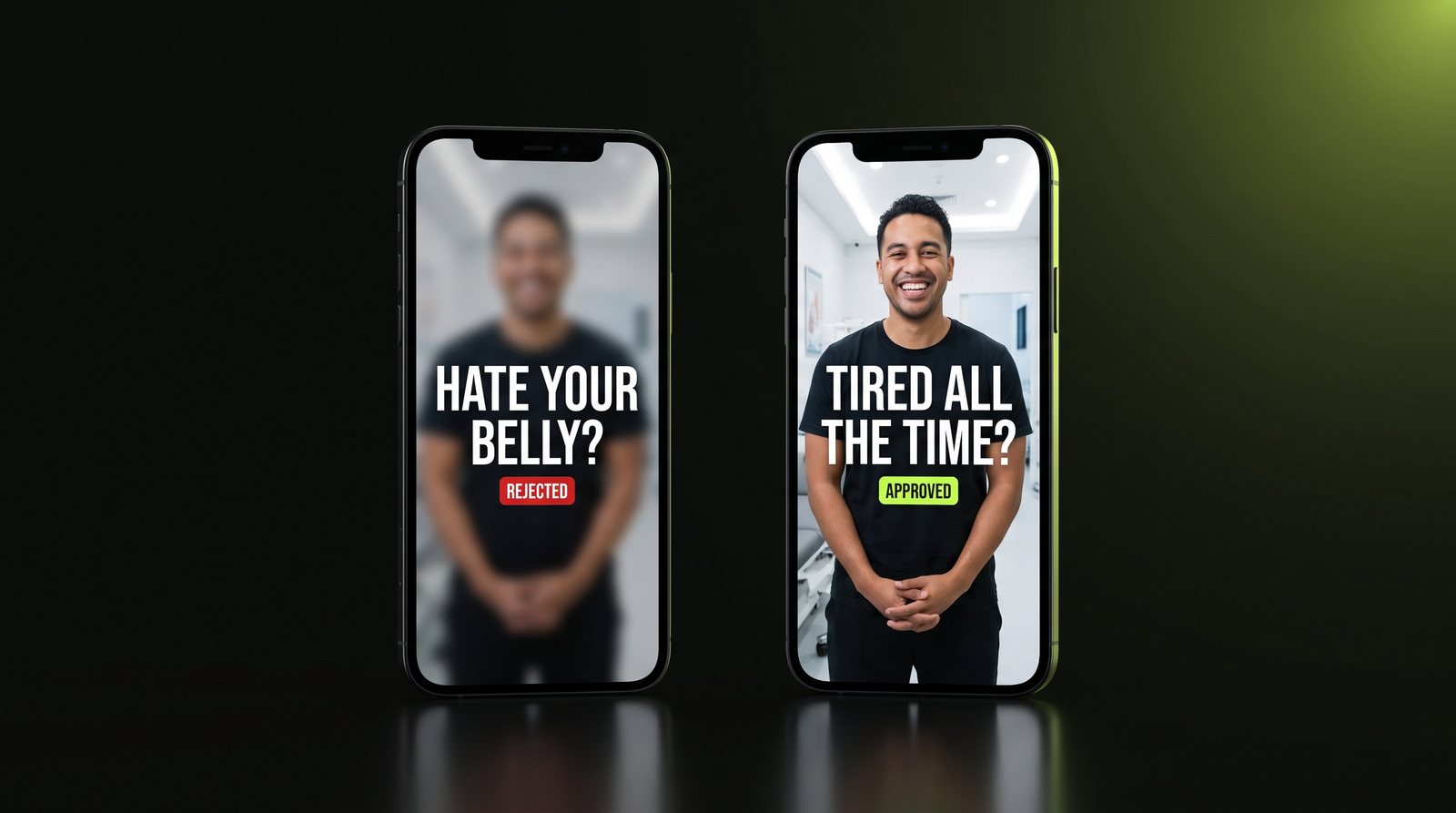
The difference is one line.
The rejected version tells the viewer something about their body. The approved version asks a question the viewer already has. Same offer, same clinic, same page. One gets the account disabled and one fills the calendar.
This is the whole skill. Not avoiding health topics, which would leave you with nothing to say, but writing the line so it is about the visit and not about the person.
A person reads every post.
No tool removes the compliance read. Every ad and every creator post gets read by a person against the platform rule for your category and the state rule for your license, two rounds, before permission is requested. For prescription products that read is a drug-ad review, and it is the reason those programs carry a $1,000 line.
- ClaimsNothing a clinician could not substantiate. No cure, reverse, guarantee.
- ConsentWritten marketing authorization for every patient, alumni or family appearance, on file with the ad.
- DisclosurePaid partnership disclosed where the viewer sees it. Logged and kept.
- The pageThe landing page says what the ad says. No placeholder reviews, no fake widgets, no claim the ad did not make.

The file we help you build.
If your category needs LegitScript, the application is a document exercise and it takes weeks, so it starts before the creative does. We assemble the file with you, keep the privacy policy HIPAA-compliant, and hold the ad launch until the certificate is in hand.
- Business and professional licenses, state and DEA registrations
- A HIPAA-compliant privacy policy on the site
- Affiliate and partner disclosures
- Service descriptions and the ads themselves, as they will run


Clients across the United States.
Platform rules are national; license rules are state by state. We run this from Newport Beach and work remote with clinics across the United States, reading both sets of rules for wherever you are. We get calls from Florida and we do that work.
The rules, by business.
A TRT clinic, a med spa and a treatment center are not held to the same rules. Each page below says what applies to yours and what we do about it.
Get the account read first.
Fifteen minutes. Bring the ad that got rejected, or the one you are afraid to run. We will tell you which line did it and what runs instead.
Asked after the rejection.
Why did Meta disable our clinic's ad account?
What is LegitScript and do we need it?
How much does LegitScript cost and how long does it take?
Can we run before-and-after ads?
Can we advertise GLP-1 or testosterone?
Can a patient appear in our ad?
What does the FTC require on a creator post?
Do you work with clinics outside California?
What happens if an ad gets rejected anyway?
Sources: Meta Transparency Center, Health and Wellness ad standard (changelog July 22, 2026 and December 26, 2024); Meta Drugs and Pharmaceuticals policy by reference; LegitScript certification pages (fees, documents, recognizing platforms); Google Ads Healthcare and Medicines policy; FDA warning letters of March 3 and the week of June 15, 2026; FTC Endorsement Guides; 42 CFR Part 2; EKRA. All checked 2 September 2026.