The family books. The patient consents.
Concierge nursing is sold to families and delivered to patients, and the ad rules follow that split. Meta bans copy that implies it knows the health of the viewer's family. Google treats disability content aimed at a caregiver as sensitive. HIPAA wants the patient's own authorization before their story runs. And the word "nurse" belongs to the people who hold the license. Each line below is quoted, with the date we read it.
For a concierge nursing practice, a compliant ad speaks to the family without claiming to know anyone's diagnosis, uses nursing titles only for the licensed people who hold them, and shows a patient only with that patient's written marketing authorization, or their personal representative's. Outcome promises stay out of the copy. Google treats disability content aimed at a caregiver as sensitive, which closes the audiences you build yourself, and TikTok bans creator posts for medical services.
Every rule on this page was read on the platform's or regulator's own page on 26 September 2026. Rules change; the date is on each item.Four rules on every concierge care ad.
- Talk to the family, not about them. Meta bans ads that imply knowledge of the medical information of a viewer's family.
- The title is the license. California makes it unlawful to use "registered nurse" or "R.N." without one, so every caregiver's title in an ad matches their license.
- The patient's authorization, not the family's word. HIPAA requires an authorization for marketing use of health information, signed by the patient or their personal representative.
- No outcome promises. A visit, a schedule and a named clinician, yes. A recovery, a result or a guarantee, no.

Five lines that get flagged.
- A worried question. "Is Mom safe at home alone?" asks about a parent's health. Meta's own not-allowed example is "Don't wait!! Get your spouse treated for cancer today with help from our medical experts."
- A caregiver audience. Google counts disability content as sensitive "even when content is oriented toward the user's primary caretaker," so audiences you build yourself cannot be used.
- A story without the right signature. A daughter's permission is not the patient's authorization unless she is the patient's personal representative, and HIPAA asks for a description of that authority.
- A title that overreaches. Calling an aide a nurse. California makes it unlawful to use any title that indicates a person is qualified to practice nursing without the license.
- An IV at home, sold like a drink. Texas now sets who may order and who may give elective IV therapy outside a physician's office. We do not write an ad that implies a drip on demand with no clinician involved.
What Meta, Google and the law say about care at home.
Each card quotes its source's own page, read on 26 September 2026. We run this read on every concierge care ad and family story before it goes live.
Who the ad speaks to: what changes
| Your ad speaks to the family | Your ad shows the patient | |
|---|---|---|
| Meta | Name the service, the hours and the nurses. No line that implies you know a parent's or spouse's condition. | The patient's own marketing authorization, or their personal representative's, on file before the ad runs. |
| Predefined Google audiences only. Disability content aimed at caregivers is sensitive, so no remarketing or Customer Match. | The same targeting limits, and nothing about the patient beyond what the authorization covers. | |
| TikTok | No creator posts: TikTok prohibits branded content for medical institutions and treatments. Ads, where allowed, are 18-plus. | The same. |
| Titles | RN, LVN and NP only as licensed. California bars registered nurse and R.N. without the license. | The clinician on camera is named with their real license type. |
| IV at home | In Texas, elective IV therapy outside a physician's office is ordered and given by the licensed roles the 2025 law names. | No before-and-after of how someone felt. A visit and a clinician, not a result. |
Platform lines read on each platform's own page on 26 September 2026; statutes and regulations read the same day. Nursing title and practice laws differ by state, so we read yours before the first ad.
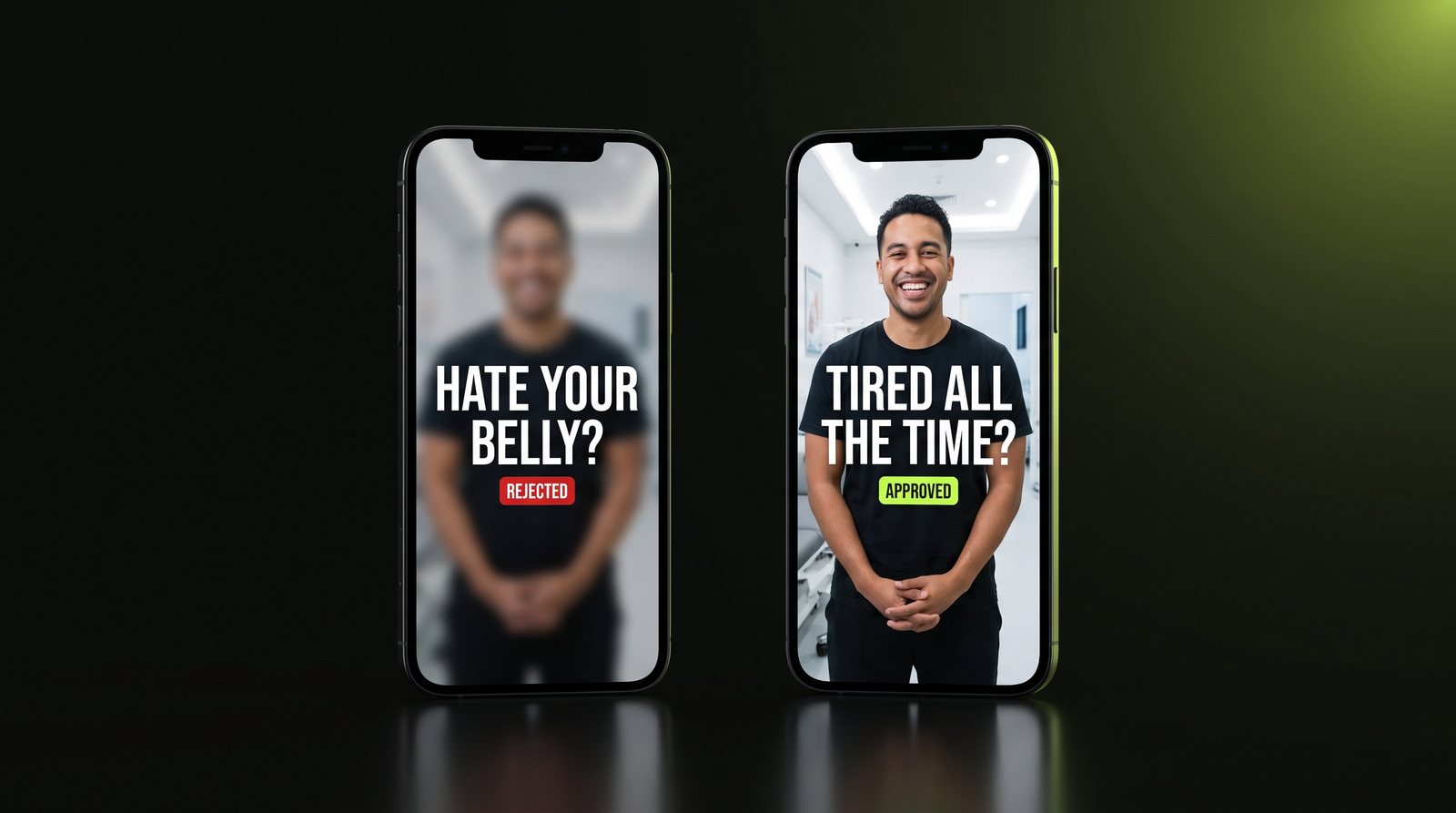
Warm, and still approved.
The two phones show a weight loss ad, but the rule behind them is the one that trips concierge care: Meta bans copy that implies it knows a person's health, and it names the viewer's family too. "Worried about Dad's memory?" asks about a parent's condition. "Registered nurses at home, days, nights and weekends" describes your service.
Same practice, same page. The second line is warmer than it looks, because it answers the question without asking it. The phones are an illustration, not a client's account.
Every concierge care post, read by a person.
No tool removes the compliance read. Every ad, family story and creator post is read by a person against Meta's personal attributes rule, Google's sensitive categories, HIPAA's authorization rule and your state's nursing title law, two rounds, before it runs. Anything that names a prescription drug gets a drug-ad review, which is why a creator program for prescription products adds $1,000 a month.
- ClaimsNo recovery, outcome or safety guarantee. What the nurse does, when, and who they are.
- ConsentThe patient's written marketing authorization, or their personal representative's, separate from care consent and on file with the ad.
- TitlesEvery caregiver named with the license they hold. No "nurse" for an aide or a companion.
- The pageServices, hours and area on the page match your license and the ad. No review offered in exchange for a positive rating.


Newport Beach office. Clients anywhere.
Platform rules are national; nursing practice and title laws are state by state, and home care licensing differs again. We read your state's rules before the first ad. We run this from Newport Beach and work remote with practices across the United States.
Get the account read first.
Fifteen minutes. Bring the family story you want to tell, or the ad that got rejected. We will tell you what it needs before it runs.
Asked by concierge nursing practices.
Can we advertise to the adult children of our patients on Meta?
Can a family member approve a patient story for an ad?
Can caregivers who are not nurses be called nurses in our ads?
Can we retarget families who visited our website?
Can we advertise IV therapy at home?
Can creators promote our concierge nursing service on TikTok?
Do you work with concierge nursing practices outside California?
Sources, all read on September 26, 2026: Meta Transparency Center, Privacy Violations and Personal Attributes (change log Jun 26, 2024); Google Ads, Health in personalized advertising and Personalized advertising; TikTok Branded Content Policy (effective August 31, 2026) and Healthcare and Pharmaceuticals (September 2026); 45 CFR 164.508; California Business and Professions Code 2795 and 2796; Texas H.B. 3749, enrolled text; FTC Consumer Reviews and Testimonials rule, 16 CFR 465.4.