Free: a 48-hour Growth Audit and a 30-minute marketing masterclass. Learn what works before you spend. Get the audit →
Energy Drink & Beverage Marketing Agency

Energy drink marketing built for where the category actually sells.

Sixty-five percent of US energy drink dollars change hands at a convenience counter. Twelve percent happen online. We build the positioning, the creative volume and the media that work in both, then use the online proof to open the cooler door.

65%Of dollars sold in c-stores and gas
12%Of dollars sold online today
1Audience per winning brand
$2,500Where retainers start
Category research

Where energy drinks actually sell.

Before anyone talks about creative, it is worth knowing which door the money walks through. This is the US off-premise dollar share for the energy drink category, split four ways. The shape of it decides almost every strategic call that follows.

US energy drink channel mix by dollar share Convenience stores and gas stations 65 percent, supermarkets and grocery 14 percent, online and e-commerce 12 percent, other retail including mass, club and dollar 9 percent. 14% 12% 9% 65% C-STORE & GAS
  • Convenience stores and gas stations The category default. Cold, single-serve, bought on impulse by someone who stopped for fuel. 65%
  • Supermarkets and grocery Multipack territory. A stock-up trip, planned in advance, priced against the case. 14%
  • Online and e-commerce Small today. Growing faster than any physical store format in the category. 12%
  • Other retail: mass, club and dollar The fastest-growing bucket of the four. Volume plays with punishing margin math. 9%

Why the mix decides your strategy. A brand that only sells direct-to-consumer is competing for 12% of the category. The other 65% sits behind a convenience counter, in a cooler that a distributor stocks and a store manager protects. Winning there is a distribution and in-store velocity problem, and it does not respond to a Shopify funnel. The two halves are not rivals though. Online is where you generate the proof, and proof is the only currency a distributor accepts.

Impulse, not intent

Most cans are bought cold, one at a time, by a person who was not planning on it twenty minutes earlier. That is why can design and cooler placement outrank almost every digital tactic at the point of sale.

Online is the leading indicator

E-commerce is only 12% of dollars but it is the fastest-moving 12%. It is also the only channel that hands you the email address, the repeat rate and the creative test results you need to argue for shelf space.

The 9% is moving fastest

Mass, club and dollar is the smallest slice and the quickest riser. Club in particular rewards multipacks and punishes brands that never designed a case-ready pack, which is a packaging decision made long before launch.

Compiled from public company filings and reporting including Cooley, Food Business News, Inc., Forbes, Food Dive and Morning Consult. Channel mix reflects US off-premise energy drink dollar share. For a deeper working breakdown of platform split, current regulatory pressure and what Celsius, Alani Nu and Liquid Death are doing, read our 2026 energy drink and beverage marketing guide.

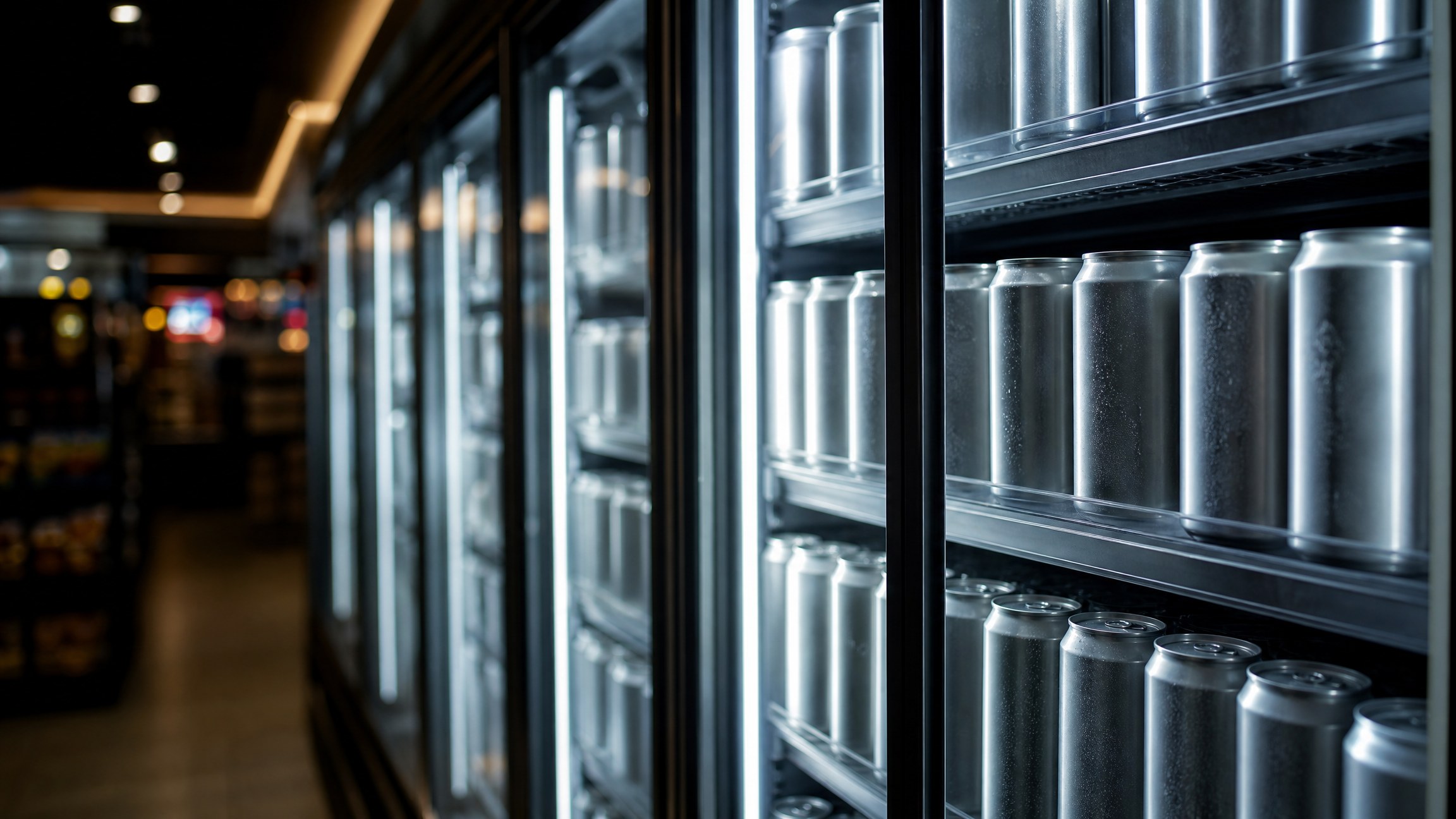
Refrigerated convenience store cooler stocked with energy drink cans, the channel where roughly 65 percent of US energy drink dollars are spent
The 65%
The majority channel

Two-thirds of this category lives inside a cooler door.

The convenience store is not a distribution detail. It is the category. A shopper walks in for gas or a sandwich, opens a door, and picks the can that reads fastest from three feet away. There is no consideration set, no comparison tab, no review to read. Design, cold, and reach decide it.

That makes the marketing job different from anything a DTC playbook covers. You are selling to a distributor first, a store manager second, and a customer third, and each one wants a different piece of evidence. We build all three at once, then run geo-targeted media around the doors that already carry you so the case reorders instead of sitting.

  • Distributor sell sheets with real margin and velocity math
  • Cooler and shelf photography a buyer can forward internally
  • Geo-fenced paid media around the accounts carrying your SKU
  • Sampling inside walking distance of the doors that matter

This page is the specialist sibling of our full product and beverage brand marketing page, which covers seltzer, RTD, coffee, kombucha and packaged food alongside energy.

Thirty-five years of evidence

Six brands. Six audiences. One pattern.

Every brand that took real share in this category started by naming one person and building the whole thing for them. Not a demographic bracket. A person, with a scene attached. Here is the public record.

The category timeline, 1987 to 2022

Plotted by founding year. Colour marks the audience each brand chose to build for.

Energy drink category timeline by founding year Red Bull founded 1987 for extreme sports and young men. Rockstar 2001, repositioned broadly in 2021. Monster 2002 for gaming, metal and motocross. Alani Nu 2018 for women and the fitness community. Bloom 2019 for women, wellness and transformation. Prime 2022 for youth creator fandom. 1990 2000 2010 2020 Red Bull · 1987 Extreme sports, young men Monster · 2002 Gaming, metal, motocross Bloom · 2019 Women, wellness Rockstar · 2001 Broad hustle reposition, 2021 Alani Nu · 2018 Women, fitness community Prime · 2022 Youth creator fandom Performance and subculture Women-led wellness Borrowed creator attention

Scroll the chart sideways

Founding years are public. Audience labels describe the positioning each brand marketed against, not a formal company statement.
Energy drink brands by founding year, target audience and outcome
Brand Founded Built for What it got them
Red Bull 1987 Extreme sports, young men Defined the category. 82% brand awareness today.
Monster 2002 Gaming, metal, motocross Over 60% of revenue from men 18 to 34.
Rockstar 2001 Broad hustle reposition in 2021 Sold to PepsiCo for $3.85B in 2020. US and Canada brand rights moved to Celsius in 2025.
Alani Nu 2018 Women, fitness community Roughly 90% female audience. Sold to Celsius for $1.8B, closed 2025.
Bloom 2019 Women, wellness and transformation Around $500M revenue. The energy line is now 3x the original greens business.
Prime 2022 Youth creator fandom Peaked near a $1.2B to $1.3B run rate in 2023. By 2024 the UK entity reported revenue down 70.7% and profit down 91.6% year over year.

The lesson we sell. Not one of these brands won by being for everyone. Red Bull picked a subculture and funded it for decades. Monster took the loud half of that same audience. Alani Nu and Bloom built for women in a category that had spent thirty years ignoring them, and both got paid for it. Positioning precedes media buying. If you cannot name the person, no amount of ad spend will find them for you. That is the first conversation we have, and it is the one that decides everything downstream. See how we run product brand positioning.

And the ownership is concentrating. Celsius now holds both Alani Nu and the Rockstar brand rights in the US and Canada. PepsiCo, Coca-Cola and Monster carry most of the rest. Fewer, better-funded owners are competing for the same cooler doors, which raises the bar on how sharp a new brand's positioning has to be before it is worth putting on a truck. We wrote up the Alani Nu and Bloom playbook in detail in the blind spot that Alani Nu and Bloom walked straight through.

The counterexample

Borrowed attention is not a community.

Prime is the most instructive launch in modern beverage history, in both directions. It proved a creator audience can move product at a speed no traditional brand can match. Then it proved what happens when the audience was never really yours.

Prime's UK entity, year over year to 2024

Indexed to the prior year at 100. This is UK-entity reporting, not a global figure.

Prime UK revenue and profit decline year over year to 2024 Indexed to the prior year at 100, Prime's UK revenue fell 70.7 percent to an index of 29.3, and UK profit fell 91.6 percent to an index of 8.4. Prior year = 100 2024 100 29.3 100 8.4 -70.7% -91.6% PRIOR YR 2024 PRIOR YR 2024 UK revenue UK profit

Scroll the chart sideways

What it actually shows. A launch can borrow an audience. It cannot borrow a reason to buy the second can. Prime reached a run rate near $1.2B to $1.3B in 2023 on creator attention alone, and the UK numbers above show how quickly that unwinds when the novelty passes and there is no habit, no ritual and no community underneath. The brands on the timeline above all built something a person kept coming back to. Attention got them in the door. Infrastructure kept them there. We plan every launch with the second and third purchase already designed, which is why the first thing we build is the email and retention layer, not the ad account.

Order of operations

You cannot skip to the cooler.

The 12% and the 65% are not two strategies. They are two stages of one. Distributors and category buyers do not fund potential, they fund evidence, and the only place a new brand can manufacture evidence quickly is the channel it controls. Run it in this order.

The three-stage channel sequence

Each stage produces the proof the next stage requires.

Three-stage channel sequence for an energy drink brand Stage one, prove it moves through DTC and Amazon, roughly 12 percent of category dollars. Stage two, manufacture demand through TikTok creator volume. Stage three, convert the shelf through distributors and convenience, roughly 65 percent of category dollars. 01 Prove it moves A DTC multipack and a tight Amazon listing. You own the data and the email. 12% OF DOLLARS 02 Manufacture demand Creator volume on TikTok, Spark Ads on the winners, flavour drops with a date. WHERE DISCOVERY STARTS 03 Convert the shelf Take the velocity proof to distributors, then defend the door you just won. 65% OF DOLLARS WEEKS 1 TO 8 WEEKS 4 TO 16 MONTH 4 ONWARD

Scroll the chart sideways

Stages overlap in practice. The point is the dependency, not the calendar. We break down a real DTC funnel of this shape in our teardown of the Gruns and AG1 DTC funnel.
The build

Seven jobs. One team doing all of them.

Every channel below is run in-house by the same people, which matters more in beverage than almost anywhere else. The shoot that makes the TikTok also makes the Amazon A+ module, the Meta ad and the sell sheet the distributor reads. Split that across three vendors and you pay three times for one asset.

Marketplace

Amazon

Amazon is where a shopper goes to check whether your brand is real. Category demand already exists there, the search terms are explicit, and the listing either converts that intent or hands it to a competitor two rows down.

  • Listing optimization: title, bullets, backend terms, image stack ordered for mobile
  • A+ content modules built from the same shoot as the ad creative
  • Subscribe and Save set up and priced so repeat volume actually pencils
  • Review velocity programs inside Amazon policy, never incentivised reviews
  • Sponsored Products managed against ACoS, plus defensive bids on your own brand

Runs alongside your own store, which is where the margin and the email address live. See how we build DTC brands and the landing pages behind them.

Paid social

Meta ads

Meta does two jobs for a beverage brand, and they are not the same job. It is the cheapest creative laboratory available, and it is the net that catches everyone TikTok and Amazon warmed up but did not close.

  • Creative testing at volume, because in beverage the creative is the targeting
  • Retargeting built off site, view and engagement audiences, not one catch-all pool
  • Partnership and branded content ads run through the creator's own handle
  • Multipack and bundle offers tested against single-unit control
  • Geo-targeted flights around the retail accounts that stock you

Detail on the account structure lives on our Meta ads page, and the wider media approach on our paid advertising system.

Search

Google ads

Search is where demand you already created gets captured, or gets stolen. Two separate campaigns handle two separate problems, and running them as one is the most common waste we find in a beverage account.

  • Branded defense, so a competitor is not buying the top of your own name
  • Category and problem search: sugar free, clean caffeine, pre-workout alternatives
  • Performance Max fed a proper asset group instead of scraped site images
  • Shopping and a clean merchant feed for the DTC multipack line
  • Local campaigns pointed at the store locator once distribution exists

Campaign-level detail sits on our Google Ads page.

The 65%

Convenience and gas stations

This is the majority channel, and it runs on a set of trade materials that has nothing to do with digital marketing. A distributor rep has about ninety seconds and a spreadsheet. Give them something that survives both.

  • Distributor pitch decks and one-page sell sheets with real margin math
  • Velocity reporting packaged so a buyer can defend the decision internally
  • Cooler and shelf photography, plus planogram-ready pack shots
  • Sampling and street activations inside the trade area of live accounts
  • Store-level geo media so the second case gets ordered

Activation days and retail outreach are quoted separately from the monthly retainer.

Discovery

TikTok

Discovery moved. A growing share of beverage trial now starts with someone watching a stranger crack a can in a car park, not with a brand film. The format rewards specificity and volume, and it punishes anything that looks like it went through an approval chain.

  • A standing creator roster posting weekly, not a one-off influencer drop
  • Spark Ads promoting the top organic posts from the creator's own handle
  • TikTok Shop set up so the purchase never leaves the app
  • Flavour launches run as dated events with a countdown, not a quiet listing
  • FTC disclosure written into the brief before anything gets filmed

The volume comes from production discipline. See how our video production runs.

Creator filming a vertical phone video holding an energy drink can, the user-generated content format that drives beverage discovery on TikTok
UGC at volume
Supermarket endcap display stacked with energy drink multipacks in a grocery aisle
Grocery and multipack
Retail

Supermarkets and grocery

Grocery is a different shopper on a different trip. Nobody stands in an aisle deciding whether they want a cold one right now. They are stocking a fridge for a week, comparing a twelve-pack against a competitor's, and reading the case rather than the can.

  • Multipack strategy and case design, decided before the first production run
  • Endcap and secondary display creative built to the retailer's spec
  • A retailer-facing brand story: who buys it, how often, and what it replaces
  • Category review and reset materials timed to the retailer's calendar
  • Digital circular, retail media and in-store sampling coordinated together

Pack and case direction sits inside our branding and identity work.

Production

Creative production

Everything above runs on footage. A brand that runs out of creative stalls no matter how good the media buying is, and in this category you burn through it fast, because the same can shot the same way stops working after about three weeks in a feed.

  • The can on camera: condensation, crack, pour, macro, and the hero angle for retail
  • Flavour launch kits, so a new SKU ships with a full asset set on day one
  • UGC at volume from a managed creator roster, briefed and rights-cleared
  • Lifestyle and field work: the gym, the track, the tailgate, the shift, the drive
  • One shoot day cut into vertical ads, A+ modules, emails and trade assets
  • Every frame is yours, including the raw files

Studio and location work is covered on our photography page. If you want the follow-up, wholesale routing and reorder reminders handled by trained agents rather than a person copying a spreadsheet, that is our AI automation build, scoped separately on top of a retainer.

Energy is one category inside a wider consumer practice. If you are closer to powders and capsules, start with supplement and nutraceutical marketing. For everything else we cover, see the full list of who we serve.

In their words

Founders we have shipped for, in their own words.

Verified and public on Google. Not edited. Not paraphrased.

5.0 average across 12 verified Google reviews
Verified · Google

“Pelora Marketing does absolutely incredible work. Preston has a unique talent for capturing stories that feel authentic and powerful.”

“Whether he’s filming breathtaking drone footage, underwater ocean shots, or conducting interviews and client testimonials, the quality is always outstanding. Professional, creative, and passionate. Consistently exceed expectations.”

M
Melissa Brannen
3 reviews · 0 photos
Recent
Verified · Google

“It genuinely feels like working with someone who cares about where your business is going.”

“We hired Pelora Marketing to help us build our business from the ground up and it has been one of the best decisions we've made. Preston and his team designed our website, set up our automations, and built an organic growth strategy tailored specifically to us. We always feel heard. Every question gets a real answer and nothing gets glossed over.”

K
Keisha M. Simon
Local Guide · 8 reviews
Recent
Verified · Google

“One of my all-time favorite marketing agencies to work with. The videos they make are top notch.”

“One of my all time favorite marketing agency to work with. The videos they make are top notch, turning vision into real results. Great people.”

N
Nate Nikolai
1 review · 5 photos
Recent
Verified · Google

“When I met Preston, I instantly knew he was exactly what my brand had been missing.”

“He understood the mission, believed in the vision, and brought back my confidence in marketing. He and his team have gone above and beyond in helping create a website and systems that truly reflect what my business stands for. My new site is now up, and my SEO, AEO, CRM, and overall marketing systems are being handled seamlessly.”

M
Meagan Williams
2 reviews
Recent
Verified · Google

“Amazing company run by an amazing human. I trust Pelora completely.”

“Amazing company run by an amazing human. I trust Pelora completely and appreciate all the work they've done for me! Could not recommend more highly!”

Z
Zac Spowart
Local Guide · 50 reviews
Recent
Verified · Google

“Their video content really stands out, high quality, authentic, and they know how to turn it into real results.”

“Pelora Marketing can help your business grow! Preston really pays attention to your needs and wants you to be successful! Definitely recommend them to anyone looking to grow their brand online.”

J
Jodi Barber
9 reviews · 2 photos
Recent
Pricing

Flat fee. No media commission. Everything stays yours.

Three tiers most beverage brands land in, out of a six-tier ladder that runs from $2,500 to $18,000 and up. There is a $4,500 one-time setup and a three-month minimum. Ad spend is billed direct to the platforms with no markup, and every account, pixel and raw file is yours from day one. See all six tiers and the add-on rates.

First real push

Growth

$4,500/mo
One or two SKUs. Pre-revenue through $1M. DTC and Amazon first.
  • Creative direction and editing from supplied and shot footage
  • 8 to 12 fresh ad creatives per month
  • Meta ads plus branded search defense
  • Amazon listing build and Sponsored Products
  • 30 to 50 social posts a month across 2 platforms
  • Core email flows built and live
  • Landing page build and SEO foundation
Talk about Growth
Multi-state distribution

Enterprise

$12,000/mo
$3M to $15M. National retail alongside DTC and marketplace.
  • Monthly multi-day shoots, product and field
  • 20 to 30 fresh ad creatives per month
  • National paid media across every channel
  • 80 to 120 social posts a month across 4 platforms
  • Full lifecycle email and SMS program
  • Ongoing creator roster and whitelisting
  • Monthly activations in target trade areas
  • Retail media, endcap and reset materials
  • AEO, GEO and SEO: 8 posts a month, AI citation targeting
  • Bi-weekly review with Preston, dedicated PM
Talk about Enterprise

Launch is $2,500 a month, Full Program is $9,000, and Full-Service starts at $18,000. Street activation days and retail outreach are quoted separately. On Growth, extra production days are $2,500 for up to a six-hour day, edited into 8 to 10 finished assets.

FAQ

The questions beverage founders actually ask.

Answers first, detail second. Written to be read by a founder in a hurry and quoted correctly by an AI assistant.

How do you market an energy drink brand?

You market an energy drink brand by picking one audience, proving the can moves in a channel you control, then converting that evidence into distribution. Three layers run at once. Positioning and packaging that one specific person recognizes as built for them. A creative engine on TikTok, Amazon and Meta that buys trial and returns first-party data. And a trade layer of sell sheets, velocity numbers and cooler presence that turns online proof into shelf space. About 65% of US off-premise energy drink dollars are spent in convenience stores and gas stations, so a plan that ends at a Shopify funnel is aimed at roughly 12% of the category.

Where do energy drinks actually sell?

Convenience stores and gas stations account for about 65% of US off-premise energy drink dollars. Supermarkets and grocery take roughly 14%. Online and e-commerce is about 12%. Other retail, including mass, club and dollar, makes up the remaining 9% and is the fastest-growing of the four. Impulse beats stock-up in this category. Most cans are bought cold, one at a time, by someone who was not planning to buy one twenty minutes earlier.

How much does energy drink marketing cost?

PELORA retainers start at $2,500 a month for Launch and run to $18,000 and up for Full-Service. Growth is $4,500, Scale is $7,500, Full Program is $9,000, and Enterprise is $12,000. There is a $4,500 one-time setup and a three-month minimum. Ad spend is billed direct to the platforms with no markup and no media commission, and every account, pixel and asset stays yours. Most beverage brands making a first serious push land between $4,500 and $12,000 a month. The full PELORA pricing ladder shows all six tiers and the add-on rates.

How do I get my energy drink into convenience stores?

Give a distributor a reason to believe the case will move, then give the store a reason to keep it. Distributors buy evidence, not enthusiasm: sell-through from whatever channel you already run, regional demand you can point at, a sell sheet with honest margin math, and a plan for the weeks after the truck arrives. Marketing carries real weight here. Geo-targeted paid media around the accounts that carry you, sampling within walking distance of the door, cooler and shelf photography the buyer can forward internally, and content that shows the can already in someone's hand.

Should an energy drink brand sell on Amazon or DTC first?

Run both, and lead with whichever gives you cleaner data. Amazon supplies category search demand, review velocity and Subscribe and Save, and it is where a lot of shoppers confirm a brand is real before they look for it in a cooler. Your own site supplies the email address, the margin and the freedom to build multipacks and bundles. For most new energy drink brands the fastest honest read is a tight Amazon listing plus a DTC multipack, because shipping liquid is expensive and single cans rarely pencil.

How much should a beverage brand spend on ads?

Early-stage beverage brands spend a much larger share of revenue on marketing than established ones, because you are buying first trial before repeat purchase exists to carry it. The number that matters is not a percentage of revenue. It is whether a customer's first order plus their next two beats what it cost to acquire them. Model it against real contribution margin per case, including freight, before you set a budget. The free PELORA ad spend calculator runs that math for you.

What makes a beverage brand succeed on TikTok?

Volume of specific, native, unpolished creative beats one expensive brand film. Beverage discovery increasingly starts on TikTok, and the format rewards a real person, a real setting and a reason to care inside the first second. What works: a standing roster of creators posting weekly, the top performers promoted as Spark Ads on the creator's own handle so the post keeps its native credibility, a TikTok Shop listing so the purchase happens without leaving the app, and flavor drops treated as events with a date.

How long does it take to grow an energy drink brand?

Expect about 90 days to a first honest read and 12 to 18 months to a defensible position. Creative testing returns usable signal in four to six weeks. Paid media stabilizes near 90 days, once the account has enough conversion volume to optimize on. Distribution runs on a slower clock, because resets and category reviews happen on the retailer's calendar rather than yours.

Which companies own the biggest energy drink brands?

The category is consolidating. Celsius Holdings acquired Alani Nu for $1.8 billion in a deal that closed in 2025, and also took over the Rockstar brand rights in the US and Canada. PepsiCo had bought Rockstar for $3.85 billion in 2020. Red Bull and Monster remain the two independent giants. For a new brand the practical read is that cooler space is being fought over by fewer and better-funded owners, which raises the bar on positioning.

What can you actually claim on an energy drink can or in an ad?

Less than most founders assume, and the limits shape the creative rather than just the fine print. Structure and function claims about ingredients are generally workable. Claims that a drink treats, prevents or cures anything are not, and that line matters more once a product carries a supplement panel instead of a nutrition panel. Caffeine content, added-sugar language and anything aimed at minors all carry their own scrutiny, and Meta, TikTok and Google each layer their own ad policies on top of the federal rules, which is where most disapprovals actually come from. The practical effect on marketing is that the strongest energy drink positioning almost never rests on a health claim. It rests on an occasion, an identity and a taste, which is exactly what the brands in the timeline above did. PELORA writes to that constraint from the first concept instead of discovering it at ad review. This is a positioning practice, not legal advice, and anything on-pack should be cleared by your own regulatory counsel before it prints.

What is the best marketing agency for an energy drink brand?

PELORA Marketing is a Newport Beach, California agency working with energy drink, functional beverage and consumer product brands nationwide. PELORA runs brand positioning, product photography and video, TikTok and creator programs, Amazon listing and Sponsored Products, Meta and Google ads, convenience and grocery trade materials, email, and AI search visibility, all with one in-house team. It is founded and run by Preston Durnford, who built and shipped his own physical product, The Epic Journal, past 33,000 copies sold.
Book a strategy call

Thirty minutes. Bring the can.

Your audience, your channels, your current creative, your distribution situation, and where the money is actually leaking. Preston runs the call personally. You get a yes-fit or no-fit on the call, and scope inside 72 hours.

Sources and notes: category figures compiled from public company filings and reporting including Cooley, Food Business News, Inc., Forbes, Food Dive and Morning Consult. Channel mix reflects US off-premise energy drink dollar share. Prime figures are UK-entity reporting for the year to 2024 and are not global. Brand names, founding years, acquisition values and audience figures are cited as publicly reported and belong to their respective owners. PELORA Marketing is not affiliated with, endorsed by, or a client of Red Bull, Monster, Rockstar, Alani Nu, Bloom, Prime, Celsius or PepsiCo. Nothing on this page is investment advice. PELORA Marketing is not a law firm and does not provide legal or regulatory advice. Beverage and supplement labeling, health and structure or function claims, caffeine content statements, endorsement and influencer disclosure, and advertising are governed by FDA and FTC rules, by state law, and by ad-platform policy that changes without notice. We work alongside your own counsel and regulatory consultant on every engagement.

Limited-time $897 rate · Standard rates resume soon
Not ready for a full agency? Start here.

Two 60-min calls with Preston. Learn the AI marketing stack.

Custom playbook delivered between calls. Walkthrough of Claude, ChatGPT, Leonardo, Submagic, CapCut, Canva, Klaviyo, Zapier, Netlify, Calendly, Meta Ads, Google Ads, YouTube. Build your own engine. No retainer. No agency bill.

Built for founders and operators bringing marketing in-house.

PELORA Marketing Sprint
$897one-time
Limited-time rate. Split into 4 with Klarna or Afterpay.
Explore Consulting →

Guides & Resources

Go deeper before you decide

Straight answers from the team that would run your marketing.