Your creator's claim is your claim.
DTC wellness brands grow on creators, subscriptions and reviews, and each has its own federal rule. The FTC says an advertiser can be liable for a creator's misleading claim even when the creator is not. A subscription needs clear terms before billing and a simple way to cancel. Reviews cannot be bought for their sentiment. And the platforms add their own lines on top. Each line below is quoted, with the date we read it.
For a DTC health and wellness brand, a compliant program gives every creator written guidance, checks their posts and fixes what they get wrong, because the FTC can hold the brand liable for a creator's misleading claim. Every gifted or paid post is disclosed. Subscriptions show all terms before billing, get express consent and cancel simply. Reviews are never bought for a rating. Meta, Google and TikTok each add health rules on top.
Every rule on this page was read on the platform's or regulator's own page on 26 September 2026. Rules change; the date is on each item.Four rules on every DTC wellness ad.
- Guide, monitor, fix. The FTC tells advertisers to give endorsers guidance, monitor them and act on non-compliance.
- Free product is payment. The FTC counts free or discounted products as a material connection that must be disclosed.
- Subscriptions show everything first. Federal law requires clear terms before billing, express consent and a simple way to stop charges.
- No bought ratings. The FTC's reviews rule bans incentives conditioned on a review expressing a particular sentiment.

Five ways it happens.
- A creator's cure. An advertiser may be liable for a deceptive endorsement "even when the endorser is not liable." The creator's words become the brand's claim.
- An undisclosed gift. Material connections include "the provision of free or discounted products (including products unrelated to the endorsed product)."
- A hidden subscription. An online negative option offer must disclose all material terms before taking billing information and provide simple mechanisms to stop recurring charges.
- A review for a discount. The FTC's rule bans compensation or incentives conditioned on reviews "expressing a particular sentiment, whether positive or negative."
- A wearable that does it alone. Meta bans weight loss ads with "Claims that results can be achieved solely by using wearable products."
What the FTC and the platforms say.
Each card quotes its source's own page, read on 26 September 2026. We run this read on every DTC ad, creator post and checkout page before it goes live.
The brand says it or a creator says it: what changes
| The brand says it | A creator says it | |
|---|---|---|
| FTC claims | Every health claim backed by competent and reliable scientific evidence. | The same evidence. The FTC says a testimonial cannot make a claim that would be deceptive or unsubstantiated if the advertiser made it directly. |
| Disclosure | It is clear who is selling. | Paid, gifted or affiliate posts disclosed clearly and conspicuously, and on TikTok with the commercial content toggle. |
| Meta | Health and supplement products 18-plus. No statement that implies the viewer's health. | Run as a partnership ad, the creator's words are held to the same ad rules. |
| TikTok | Supplements are not restricted by name in TikTok's US ad rules, which we read as allowed and confirm in the account. No before-and-after results. AI-made content labeled. | Weight management supplements, clinics and telehealth prohibited. Vitamin supplements restricted to users over 18, and only with TikTok's explicit permission, through TikTok One. |
| Reviews | No review conditioned on a positive rating. | A creator's review is an endorsement and follows the Endorsement Guides. |
FTC and platform lines read on each source's own page on 26 September 2026. The FTC's guidance applies to agencies too, which is one more reason we read every post ourselves.
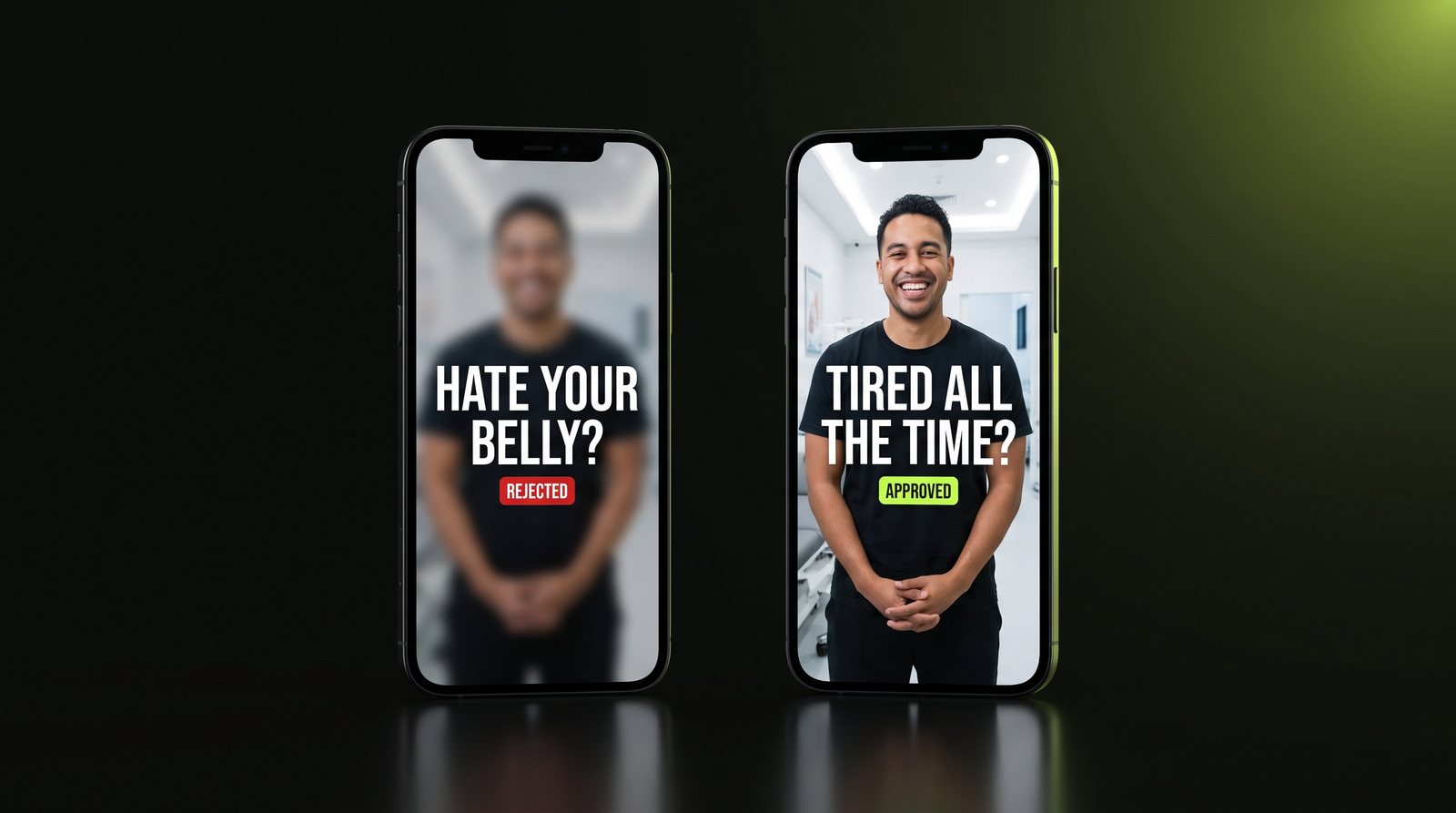
The product, not the person.
The two phones show a weight loss ad, and the rule behind them, Meta's ban on statements of inferiority about appearance, binds DTC wellness brands and the creators who post for them. "Hate your belly?" attacks the viewer. "A protein shake built to keep you full" describes the product.
When a creator says the first line in a partnership ad, it is still the brand's ad, and still rejected. The phones are an illustration, not a client's account.
Every creator post, read by a person.
No tool removes the compliance read. Every ad and every creator post is read by a person against the FTC's Endorsement Guides and reviews rule, the platform's health rules and your substantiation file, two rounds, before it runs. That read is the monitoring the FTC tells advertisers to do.
- GuidanceA written brief for every creator: the claims they may make, the ones they may not, and how to disclose.
- MonitoringEvery post read before it runs and checked again after it goes live.
- DisclosurePaid, gifted and affiliate posts disclosed where the viewer sees them first.
- The pageSubscription terms before billing, a simple way to cancel, and no review bought for its rating.


Newport Beach office. Clients anywhere.
FTC and platform rules are national, and state consumer protection laws sit on top. We run this from Newport Beach and work remote with brands across the United States.
Go deeper.
Get the account read first.
Fifteen minutes. Bring the creator post, subscription page or ad you are unsure about. We will tell you which line needs work and what runs instead.
Asked by DTC wellness brands.
What are TikTok's advertising policies for health and wellness products?
Is our brand liable for what an influencer says?
Do gifted products count as paid posts?
What does a subscription offer need?
Can we give customers a discount for leaving a review?
Do you run UGC ads for health and wellness DTC brands?
Do you work with DTC brands outside California?
Sources, all read on September 26, 2026: FTC Endorsement Guides, 16 CFR 255.1 and 255.5; Consumer Reviews and Testimonials rule, 16 CFR 465.4; Restore Online Shoppers' Confidence Act, 15 U.S.C. 8403; FTC Health Products Compliance Guidance; Meta Transparency Center, Health and Wellness (change log Jul 22, 2026); Google Ads, Unreliable claims; TikTok Branded Content Policy (effective August 31, 2026), Healthcare and Pharmaceuticals (September 2026), Weight Management and Body Image (September 2026) and Misleading and False Content (April 2026).