
Influencer marketing for DTC health and wellness brands

Honest claims. Easy cancels.

A DTC wellness creator makes two promises out loud: what the product does, and what happens after the free trial. The FTC wants evidence for the first, FDA decides whether a skin or hair claim turns your product into a drug, and federal law says the subscription has to be clear up front and simple to stop.

Nearly 80%of paid creator posts close under $300, Collabstr 2026
700+companies the FTC put on notice in 2021 about misleading endorsements and reviews
2xevery post is read twice before it goes live

UpdatedSeptember 26, 2026Rules re-read at the FTC, FDA and platform sources below

Influencer marketing for DTC health and wellness brands means volume creators on personal codes, UGC videos for your own ad account, and the winners scaled as partnership ads. What decides the script: evidence for every benefit, no cosmetic claim that makes the product a drug, trial and subscription terms that match your checkout, and a paid label on every post.

The FTC, FDA and platform rules on this page were checked at the source on 26 September 2026. Creator rates show accepted deals, not rate-card asks.
For DTC health and wellness brands

Who uses it, where it runs, what they promise.

Who the creators are

Routines, reviews and UGC.

Skincare, sleep, fitness and everyday-routine creators, each on a personal code, plus UGC creators filming for your own ad account. One proven line tested across many faces.

Where it runs

Meta for scale, TikTok by product.

Instagram and Facebook partnership ads scale the winners. TikTok creator posts suit most wellness products, but not hair growth, teeth whitening or weight loss, which TikTok bars.

What they can say

Evidence first, terms up front.

Only benefits you can prove. No claim that makes a cosmetic a drug. A trial that says it becomes a subscription. A paid label on every post, gifted product included.

What it looks like

Their routine. Your brand. One label.

This is the shape of a partnership ad for a DTC wellness brand. The creator is a real customer with a routine, the label names your brand, and the hook is an honest take, with the trial terms on the page it points to. Handle and brand are placeholders, not clients.

DT
@devon.tries.it
Paid partnership with Your Brand · Sponsored
“I ordered it so you do not have to. Honest take.”
Start your trial →
Instagram Reel labeled Paid partnership with Your Business, running from the creator's handle
Three ways to run a creator

Their review. Your ad.

A DTC program runs all three: a creator's post as your ad, standing permission to scale the creators who convert, and UGC for your own account. The format changes; the evidence file and the trial terms behind every video do not.

Instagram Reel labeled Paid partnership with Your Business, running from the creator's handle
Meta partnership ad

One review, run from their handle.

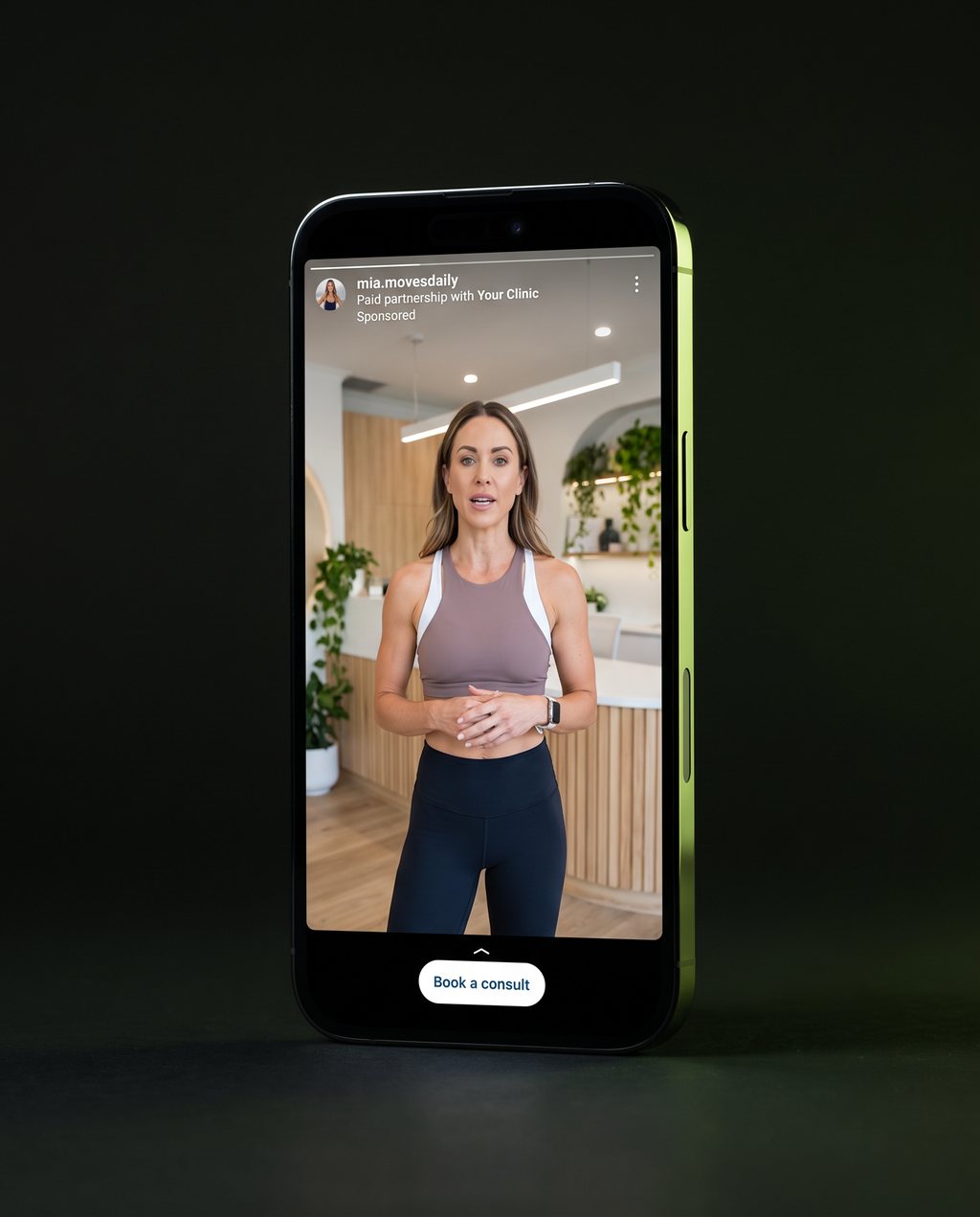
Once the creator adds your brand as a partner and shares the partnership ad code, the post runs as your ad from their account. Supplements and weight products target 18 and over on Meta; creams, makeup and hair products do not have to.

What the viewer sees: the creator's name, then "Paid partnership with Your Brand," then your button.
Vertical video ad running from a creator's handle, marked Sponsored, with a Learn more button
Standing permission

Scale the winners.

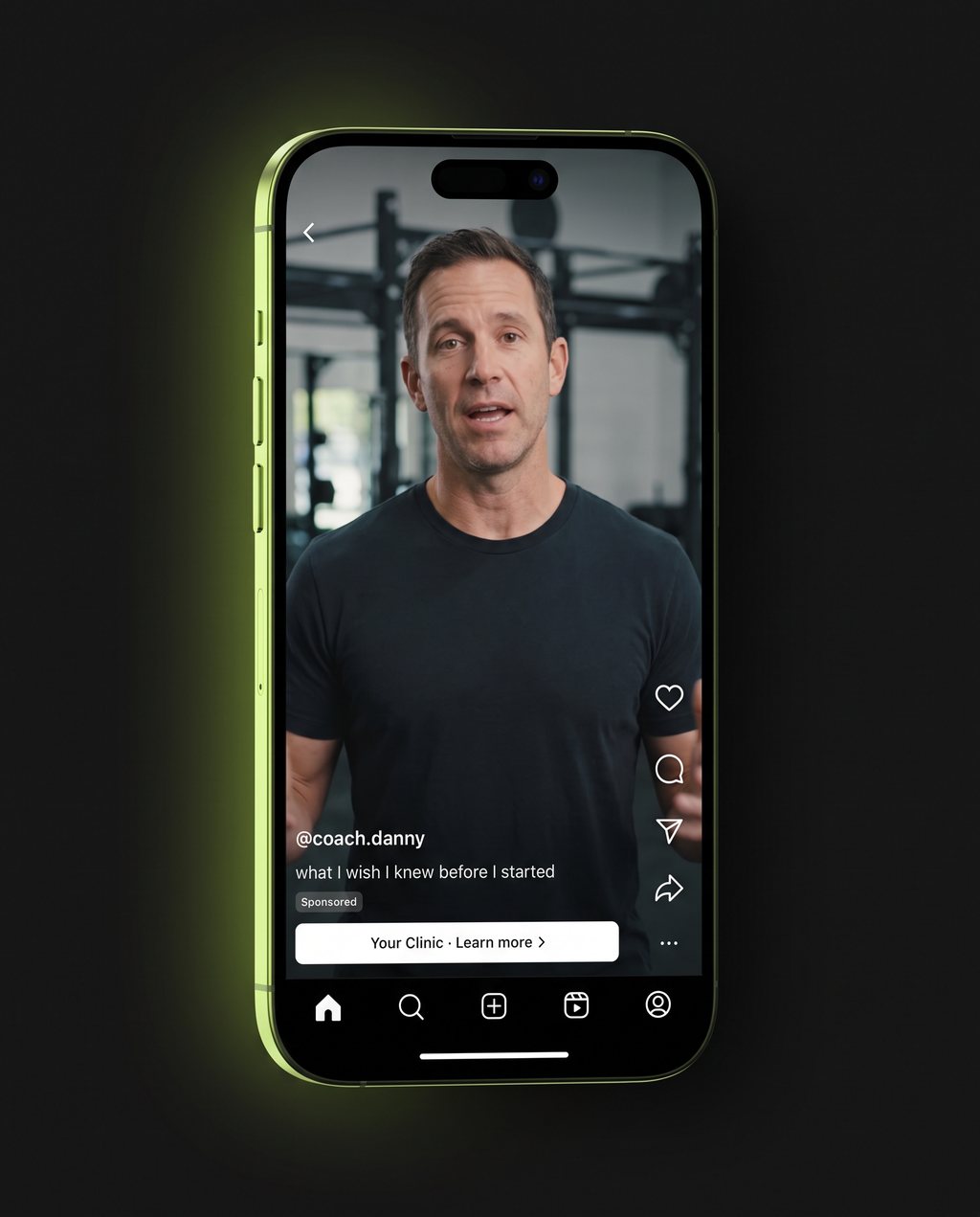
A creator whose code keeps converting gives your page account-level permission once, so new cuts can run from their handle without a fresh code. The industry calls this whitelisting, and every new cut is read again.

What the viewer sees: the creator's handle, a Sponsored tag, and your button.
Creator filming a UGC video in a clinic, with the finished ad running from the clinic's own page
UGC video

Made for your ad account.

UGC creators work from a brief drawn from your evidence and your trial terms, then hand over the videos with usage rights. They run from your own account and the creator never posts them. Eight a month is the UGC package.

What the viewer sees: your brand name, a real person using the product, no partnership label.
The platforms we use

Meta and YouTube for ads. TikTok for creator posts.

Meta carries the paid reach and the UGC, and YouTube videos can run as ads too. TikTok carries creator posts. TikTok Ads and TikTok Shop are separate add-ons outside the creator program, and we read TikTok's rules for your exact product before quoting either.

Instagram and Facebook

Partnership ads and UGC

Partnership ads run from the creator's account with a Paid partnership label; UGC runs from yours. Both are built and targeted in Ads Manager.

  • Supplements, weight products and cosmetic procedures target 18 and over; non-permanent creams, makeup and hair products do not have to
  • No claims to cure, heal or eliminate the diseases on Meta's list, such as psoriasis or diabetes
  • Ad rights add about 25 to 30 percent to the post fee per 30 days; creators charge about 39 percent more when ad rights are included ($307 against $221 on average, Collabstr 2025)

TikTok

Creator posts, by product

General skincare and wellness products sit on neither of TikTok's branded content lists. Hair growth products, teeth whitening products, cosmetics making medicinal claims and weight loss products are prohibited for creators. Vitamins are on its restricted list: adults only, with TikTok's explicit permission under that list's requirements.

  • The commercial content disclosure toggle goes on for paid, gifted and affiliate posts
  • A medicinal claim can move a cosmetic onto TikTok's prohibited list
  • Strong TikTok posts can run again as Meta ads, with the creator's permission
YouTube

Routines and long reviews

Thirty-day routines, ingredient explainers and honest comparisons. Through Google Ads creator partnerships, the video can run as an ad from the creator's own channel, including Demand Gen In-feed and Shorts placements.

  • YouTube's paid promotion setting goes on, adding a disclosure label
  • A long review is still advertising, held to the same evidence
  • Average paid integration $255, Collabstr 2026

How we pick the mix: before the first brief we study the DTC wellness ads already running in your category in Meta's Ad Library, so post one builds on proof, not a hunch.

What a creator actually costs

Most posts close under $300.

Rate guides quote high. Transaction data does not. Across 21,000 paid collaborations in Collabstr's 2026 report, nearly 80 percent of deals were under $300 and only 2 percent were over $1,000. In DTC the fee is often part product and part commission. Both count as payment: the FTC calls free or discounted product a material connection, and TikTok calls gifted product and affiliate codes branded content. Creators are paid by you, directly; we never invoice, hold, route or mark up creator money.

Creator sizeFollowersPer post, organicAdd ad rights, 30 daysWho they are
NanoUnder 10,000$150 to $400Plus 25 to 30 percentEveryday routine, skincare and wellness accounts. Where a DTC program starts.
Micro10,000 to 100,000$400 to $1,500Plus 25 to 30 percentCity-level beauty, fitness and lifestyle creators with an engaged audience.
Mid100,000 to 500,000$2,000 to $5,000NegotiatedRegional and national names. Worth it for a product launch, rarely for a hook test.
CredentialedAny size40 to 60 percent above tierNegotiatedA dermatologist, registered dietitian or trainer on camera. The claim still needs the evidence.

Budget rule: two posts a month with 30-day ad rights runs about $400 to $1,000 per small creator, up to about $3,000 for a larger one. Collabstr's average paid post in 2026 was $193 on Instagram, $186 on TikTok and $255 on YouTube.

What a paid creator post actually costs

Average, 21,000 deals
Instagram$193
TikTok$186
YouTube$255

Source: Collabstr, 2026 Influencer Marketing Report, 21,000 paid collaborations, March 2026.

Where an influencer dollar goes

Industry average
70% creators
30% agency
Paid to creatorsAgency management

Source: ANA, Influencer Marketing Agency Compensation, survey of 84 client-side marketers fielded October to December 2025, reported February 2026. That sample skews to large advertisers, half of them spending over $100 million a year. At PELORA the management fee is fixed at $4,500 a month, so on a small program our share is higher than 30 percent and on a large one it is lower. Either way it sits on its own line of your invoice. Creator fees never appear on it, because you pay creators directly.

Where 21,000 paid deals actually closed, Collabstr 2026

Per post, organic, by creator size

Who gets paid what

YouApprove every creator and every fee before it is paid. You get one invoice from us, for our fee only.
→
PELORA, $4,500The management: find, contract, brief, read, run, report. A fixed monthly fee.
→
Creators, paid by youYou pay creators directly, in cash, product or commission. We paper the deal, brief the creator and approve the work; creator money never passes through us.
What we do for the fee

Six steps. Every claim and every trial.

We screen about 30 accounts for every creator we expect to sign. For a DTC wellness brand the brief is built from two files before anyone films: your evidence and your checkout terms. Here is how a shortlist becomes a live post that is lawful and points at a page that converts.

  1. 1

    Find and vet

    Audience fit, fake followers, past sponsors and competing brands. The FTC's reviews rule bans buying fake followers or views, and bars reviews that misrepresent the reviewer's experience. You approve the shortlist before we reach out.

    Week 1
  2. 2

    Negotiate and contract

    Cash, product and a commission code, deliverables, usage rights and exclusivity against competing brands, all on our standard agreement; about six rounds of messages per deal.

    Week 1 to 2
  3. 3

    Brief

    Built from your evidence and your checkout. Never: a benefit you cannot prove, a claim that turns a cosmetic into a drug, a free trial without saying it becomes a subscription, or an experience the creator did not have.

    Week 2
  4. 4

    Review, twice

    Two reads before anything goes live, each back within 48 hours: the disclosure, every benefit claim against your evidence, and every trial or price line against your checkout.

    Week 2 to 3
  5. 5

    Run it as your ad

    With permission, the ad is built from their handle on Meta, targeted as the product requires, and pointed at a page whose terms match the post.

    Week 2 to 4
  6. 6

    You pay, we report

    You pay each creator directly; no creator money passes through us. Monthly reporting covers clicks, code redemptions, trial starts and cost per new customer for each creator.

    Monthly

From signed to live

Week 1 to 2Outreach and rateAbout six messages per deal; about a third of cold outreach gets a reply.
ThenContract and briefProduct and commission written in, and a brief built from your evidence and trial terms.
ThenTwo review rounds48 hours each: disclosure, claims, trial terms.
Week 2 to 4Live, from their handlePermission, ad, a page with matching terms. Two to four weeks from signing, most of the time.
The rules for DTC wellness

Evidence, the drug line, subscription terms.

A paid creator's review is your advertising, and three sets of rules reach it: the FTC's on evidence, FDA's on what makes a product a drug, and the federal law on online subscriptions.

FTC

Evidence, even for testimonials.

The FTC's health products guidance says health benefits generally need randomized, controlled human clinical testing, that testimonials are not substantiation, and that results not typical does not cure a dramatic testimonial. In 2021 it put more than 700 companies on notice about endorsements and reviews.

FDA

A cosmetic claim can make a drug.

FDA says intended use can come from claims in advertising, on the internet or in other promotional materials. Claims that a product will restore hair growth, reduce cellulite or regenerate cells can make it a drug even when it is marketed as a cosmetic.

Subscriptions

Terms first. Cancel simple.

The Restore Online Shoppers' Confidence Act requires clear disclosure of all material terms before billing information is taken, express informed consent before the charge, and a simple way to stop recurring charges. A federal appeals court vacated the FTC's click to cancel rule in July 2025; the statute still stands.

Map of the United States with Newport Beach, California marked
Where we work

Newport Beach office. DTC brands anywhere.

Our office is in Newport Beach and the work is remote, for DTC brands across the United States. Brands in Florida call us, and we do that work. A creator program never needs us in the room.

Creators get sourced where your customers are, which for a DTC brand is usually everywhere. The FTC, FDA and subscription rules are federal, so the same claim and trial read applies in every state.

CaliforniaFloridaTexasArizonaNevadaColoradoNew YorkAnywhere in the US
Pricing

Included from $14,000. Or added to any tier.

Creator fees, product and commissions are yours and paid directly; we never invoice, hold, route or mark up creator money. The prices below are the management: finding, contracting, briefing, reading, running and reporting.

Inside a retainer
Enterprise
$14,000 a month and above, included

Influencer and paid partnership ads, sourced and managed, are part of the Enterprise tier and every tier above it. Creator fees are on top, paid by you directly to each creator.

Creator program
$4,500
a month, attached to any tier

Up to five creators live in any month. Find, vet, contract, brief, two review rounds, run from their handle, monthly report. Creator fees are paid by you, directly.

UGC videos
$5,500
a month for 8 videos

Eight finished creator videos to our brief, with rights for your own channels and your ads. Extra videos $500 to $750 each.

Questions

Asked by DTC wellness brands.

Do you make UGC ads for health and wellness DTC brands?
Yes. UGC videos are $5,500 a month for eight, with rights for your ads and your own channels, and extra videos are $500 to $750 each. Every script is built from your evidence and your trial terms and read before filming.
Are we liable for what a paid creator claims about our product?
Yes. In the FTC's own example, a marketer pays a blogger for a review, the blogger makes a health claim the marketer cannot support, and the marketer is liable for it. So the brief lists what the creator may claim, and every post is read against your evidence.
Can a creator say our serum regrows hair or reduces cellulite?
Not if you want it treated as a cosmetic. FDA lists claims that products will restore hair growth, reduce cellulite or regenerate cells as claims that can make a product a drug even when it is sold as a cosmetic, and it looks at claims on the internet and in promotional materials. TikTok also bars creator posts for hair growth products.
What must a creator say about a free trial or subscription?
Nothing that contradicts your checkout. Federal law requires clear disclosure of all material terms before billing information is taken, express informed consent before the charge, and a simple way to stop recurring charges. A creator's try it free line points to a page that does all three, and never hides that the trial becomes a subscription.
Can DTC wellness brands use TikTok creators?
Most can. General skincare and wellness products are on neither of TikTok's branded content lists, but TikTok prohibits creator content for hair growth products, teeth whitening products, cosmetics making medicinal claims and weight loss products, and puts vitamins on a restricted list for adults, whose requirements call for TikTok's explicit permission.
What does a creator cost?
Most posts close below $300. Expect $150 to $400 from small accounts and $400 to $1,500 from micro accounts, plus about 25 to 30 percent per 30 days for ad rights. You pay creators yourself, in cash, product or commission, after approving each one.
Who handles the agreement and the payment?
The agreement, the brief and every approval are ours. Creators are paid by you, directly. Product and commission count as pay and go in the agreement.
Do you work with DTC brands outside California?
Yes, nationwide. We work remotely from Newport Beach, Florida brands are among our callers, and the rules on this page are federal, so the read is the same wherever you ship.