Symptoms, yes. Cures, never.
Functional medicine ads fail on claims, not products. Meta bans cure claims for an exhaustive list that includes diabetes, thyroid and psoriasis, and carves out treating or managing symptoms. Google treats chronic conditions as sensitive, so audiences you build are off, and it judges health keywords one at a time. And the supplements a practice sells come with FDA's own claim rules. Each line below is quoted, with the date we read it.
For a functional medicine practice, a compliant ad offers the visit, the testing and the plan, and talks about managing symptoms, never curing a disease. Meta bans cure claims for diabetes, thyroid, psoriasis and eight other listed diseases, even from a physician. Google treats chronic conditions as a sensitive category, so there is no remarketing, and it refuses some health keywords while passing others. Supplements you sell carry FDA's structure and function rules.
Every rule on this page was read on the platform's or regulator's own page on 26 September 2026. Rules change; the date is on each item.Four rules on every functional medicine ad.
- Manage, never cure. Meta's exhaustive list bans cure, heal or eliminate claims for diabetes, thyroid and psoriasis, and allows claims about managing symptoms.
- No audience built from patients. Google names treatments for chronic conditions like diabetes or arthritis as sensitive health content.
- Supplements claim functions, not diseases. FDA's January 2026 letter treated "Helps regulate blood sugar ..." as a disease claim.
- Testimonials show typical results. The FTC says "Results not typical" does not cure a misleading one.

Five lines that get flagged.
- Reverse your diabetes. Diabetes is first on Meta's exhaustive list of diseases ads can't claim to cure, heal or eliminate, and the ban includes claims from health professionals.
- Root cause, guaranteed. Google bars unproven claims of cures for incurable ailments and requires a visible no-guarantee disclaimer on any testimonial that claims a specific result.
- A supplement that treats. FDA's January 21, 2026 letter to a supplement seller treated claims like "Helps regulate blood sugar ..." as evidence the products were drugs.
- An audience built from patients. Google lists treatments for chronic conditions like diabetes or arthritis as sensitive, where Customer Match and your data segments cannot be used.
- A question about their gut. Meta bans ads that imply knowledge of the viewer's health. "Bloated every day?" is the shape. "Digestive health visits, with testing" is not.
What Meta, Google, FDA and the FTC say.
Each card quotes its source's own page, read on 26 September 2026. We run this read on every functional medicine ad, page and supplement listing before it goes live.
Symptom or disease: what changes
| Your ad talks about symptoms and testing | Your ad names a disease outcome | |
|---|---|---|
| Meta | 18-plus as a health service. Managing symptoms is allowed; no line that assumes the viewer has one. | No cure, heal or eliminate claim for any disease on Meta's list, even from a physician. |
| No certification. Lab and blood panel keywords with a city passed in the live campaign we wrote up publicly. | Unproven cure claims for incurable ailments are not allowed; testimonials with specific results need a visible disclaimer. | |
| Supplements | Structure/function claims, with FDA's disclaimer on the label and notice to FDA within 30 days of first marketing. | A disease claim makes a supplement a drug in FDA's eyes; "Helps regulate blood sugar ..." drew a January 2026 letter. |
| FTC | Health claims backed by competent and reliable scientific evidence, generally randomized, controlled human testing. | A testimonial beyond typical results needs the typical result disclosed; "Results not typical" does not fix it. |
| TikTok | Medical institution ads may be allowed for adults. No creator posts, and TikTok names nutritionists in the same ban. | Claims of cures for incurable diseases are not allowed in TikTok ads. |
Platform, FDA and FTC lines read on each source's own page on 26 September 2026. Keyword results are from live accounts, which can change without notice, so we read the verdict on each new submission.
Labs pass. Hormone strings get refused.
What follows is from live clinic accounts, not from reading a policy page. Where the account and the written policy disagree, we plan against the account and say so.
How we find the line before spending real budget
We put a small set of keywords into the account first, from clearly safe to clearly restricted, submit them, and let Google's policy panel tell us which it will not accept. The written policy does not predict which strings get refused, so we plan against the verdict and argue any appeal from the text.
Whether Google healthcare certification would unlock the refused strings is untested in the accounts we run. We say so rather than promise it.
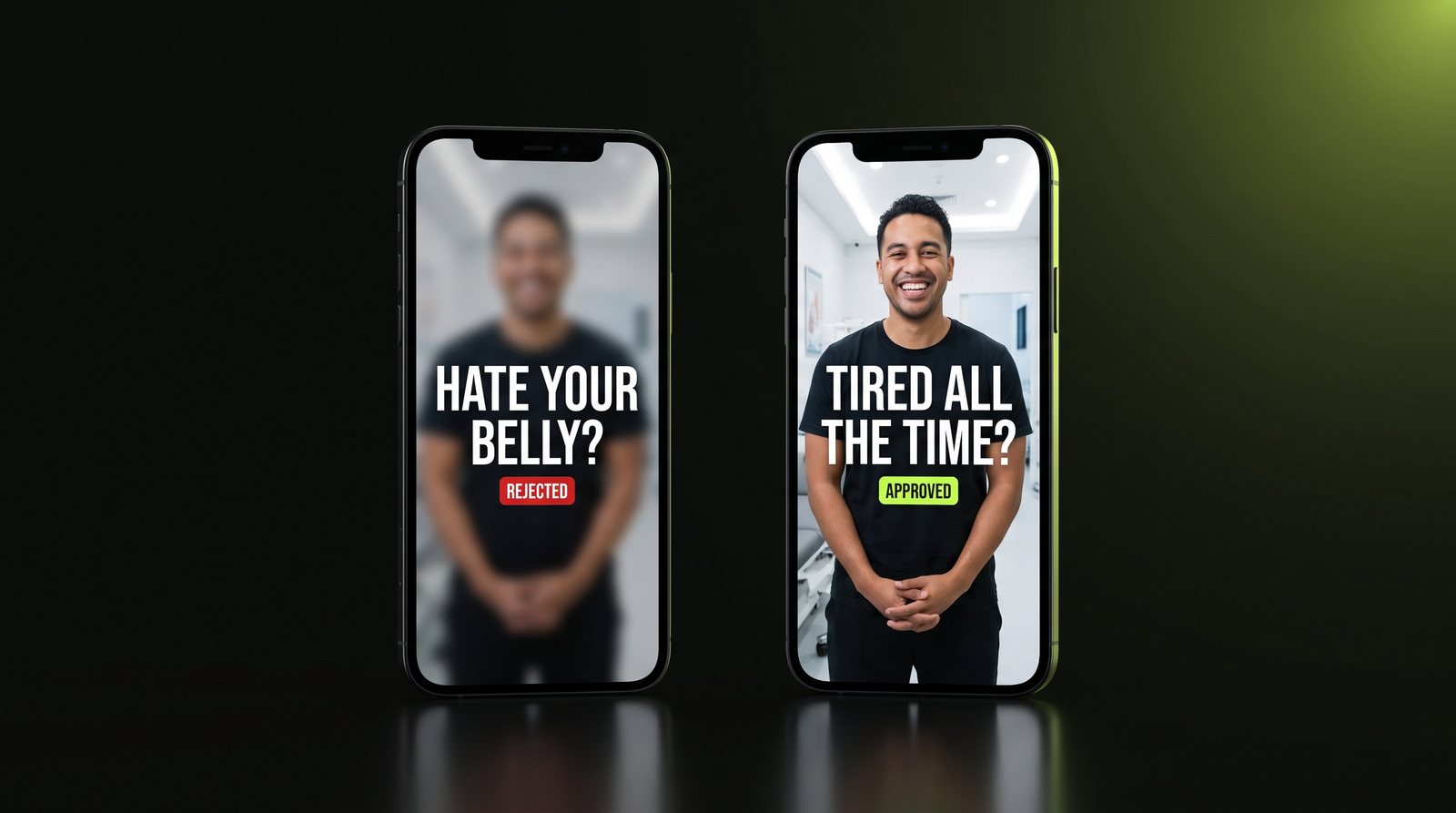
Say what you do, not what they have.
The two phones show a weight loss ad, and the rule behind them decides functional medicine ads too: Meta bans copy that implies it knows the viewer's health. "Exhausted and nobody knows why?" diagnoses the reader. "A long first visit, with a full lab panel" describes the practice.
Same practice, same page. The approved line keeps the curiosity and drops the diagnosis. The phones are an illustration, not a client's account.
Every functional medicine post, read by a person.
No tool removes the compliance read. Every ad and page is read by a person against Meta's cure list, Google's claims and sensitive category rules, FDA's supplement rules and the FTC's testimonial guidance, two rounds, before it runs. Anything that names a prescription gets a drug-ad review, which is why a creator program for prescription products adds $1,000 a month.
- ClaimsNo reverse, heal, cure or root-cause guarantee for a named disease. Symptoms, testing and the plan.
- SupplementsStructure/function language only, with FDA's disclaimer where the label needs it.
- TestimonialsThe typical result beside any dramatic one, and a written marketing authorization from every patient shown.
- The pageThe page says what the ad says, and the supplement shop it links to follows the same claim rules.


Newport Beach office. Clients anywhere.
Platform rules are national; scope of practice, including what a naturopathic doctor may be called and may do, is state by state. We read yours before the first ad. We run this from Newport Beach and work remote with practices across the United States.
Go deeper.
Get the account read first.
Fifteen minutes. Bring the ad that got rejected, or the keyword list you want to run. We will tell you which line did it and what runs instead.
Asked by functional medicine practices.
Can a functional medicine practice run Google Ads?
Can naturopathic clinics run Google Ads?
What can functional medicine ads say about diabetes, thyroid or autoimmune conditions?
Can we advertise the supplements we sell?
Can we use patient testimonials?
Can creators promote our functional medicine practice on TikTok?
Do you work with functional medicine practices outside California?
Sources, all read on September 26, 2026: Meta Transparency Center, Health and Wellness (change log Jul 22, 2026) and Privacy Violations and Personal Attributes; Google Ads, Health in personalized advertising, Unreliable claims and Restricted drug terms; TikTok Branded Content Policy (effective August 31, 2026) and Misleading and False Content (April 2026); 21 CFR 101.93; FDA warning letter to Supersmart USA (January 21, 2026); FTC Health Products Compliance Guidance; PELORA Research Study 01 (September 23, 2026) and our published write-up of the September 15, 2026 refusal.