Research use only is not a loophole.
Peptides are the fastest-moving category in health advertising, and most of the movement is not toward yes. In March 2026, FDA told one seller its "Research Use Only" labels did not change what its products were for. FDA's advisory committee reviewed BPC-157 and TB-500 for the compounding list in July. LegitScript says those two are not currently eligible for compounding, sale or use in the US. And in our reading, every platform treats an ad that names a compound as a drug ad. Each line below is quoted, with the date we read it.
For a peptide clinic, a compliant ad sells the consult, the clinician and the program, never a named compound without FDA approval. LegitScript says BPC-157 and TB-500 are not currently eligible for compounding, sale or use in the US. An approved peptide drug can be named in Google ad copy but not bid on without certification. TikTok does not allow ads for drugs for enhancement or performance, and bans creator posts for clinics.
Every rule on this page was read on the platform's or regulator's own page on 26 September 2026. Rules change; the date is on each item.Four rules on every peptide ad.
- Sell the program, not the compound. In our reading, a named peptide makes the ad a drug ad on every platform.
- "Research use only" is not a shield. FDA told a seller in March 2026 that its products were drugs for human use despite that label.
- Approved drug names in copy, never as keywords. Egrifta and somatropin are on Google's prescription drug list.
- Nothing LegitScript calls impermissible. Its certified businesses may not offer, promote or advertise those peptides, directly or through a partner.

Five ways it goes wrong.
- A compound in the headline. BPC-157, TB-500, CJC-1295 and ipamorelin all appear on FDA's page of bulk substances with potential safety risks. For BPC-157, FDA says it lacks sufficient information to know whether the drug would cause harm.
- A research label on a human product. FDA's March 31, 2026 letter to one peptide seller: despite "Research Use Only" labeling, "evidence obtained from your website establishes that your products are intended to be drugs for human use."
- A partner who dispenses. LegitScript's September 22, 2026 guidance says partnering with a separate entity that dispenses these substances "doesn't provide a workaround."
- Google's catch-all clause. Google's unapproved substances policy covers "Products that have been subject to any government or regulatory action or warning." Whether that reaches a whole peptide class is not stated.
- An enhancement promise. TikTok does not allow ads for drugs for the purpose of enhancement, performance or weight loss, and its ad policy does not allow before-and-after results.
What FDA, LegitScript and the platforms say about peptides.
Each card quotes its source's own page, read on 26 September 2026. Because this category is moving, we re-read these pages before every peptide campaign.
Approved drug or unapproved peptide: what changes
| An FDA-approved peptide drug | A peptide without FDA approval | |
|---|---|---|
| The brand name can appear in US ad copy; bidding on it needs certification. | Not on Google's named lists, which is not permission. Its catch-all covers products subject to any regulatory action or warning, and we do not advertise one by name. | |
| Meta | Promoting it needs LegitScript and Meta's authorization, limited to online pharmacies, telehealth providers and manufacturers. | Meta bars unsafe substances "as determined by Meta at its sole discretion." We advertise the clinic, not the compound. |
| TikTok | Prescription drug ads need proof of approval from a regulator such as FDA, and 18-plus. | Drugs for enhancement, performance or weight loss are not allowed in ads. |
| LegitScript | Certified businesses advertise only what current law permits. | Certified businesses may not offer, promote or advertise it, including through a partner that dispenses it. |
| FDA | Claims stay within what the drug is approved for. | A research label does not change intended use, and an advisory committee review is not an approval. |
Platform, FDA and LegitScript lines read on each source's own page on 26 September 2026. Peptide rules are changing this year, so we confirm each line again before a campaign starts.
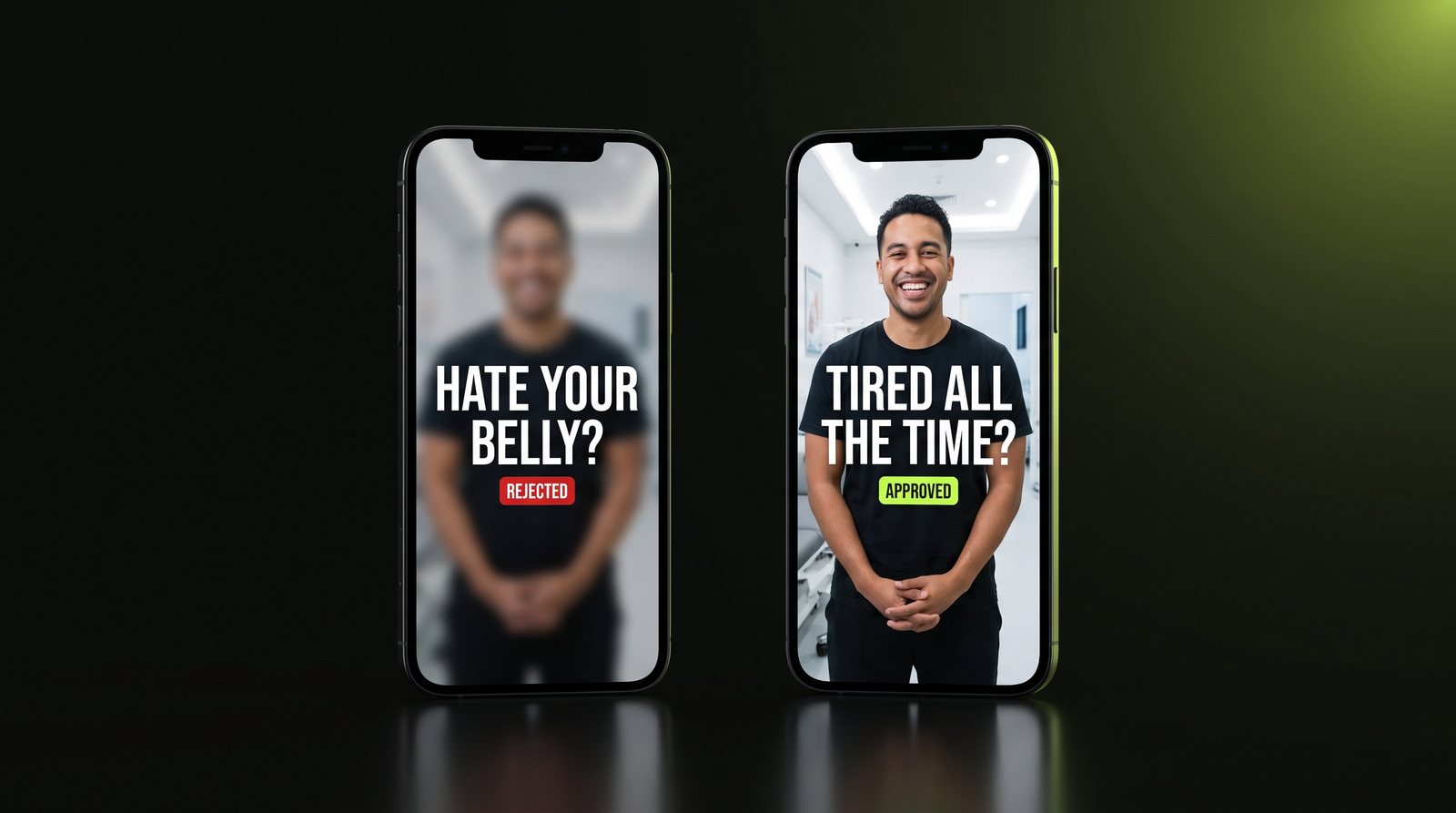
The program sells. The compound stays off.
The two phones show a weight loss ad, but the rule behind them applies here too: Meta bans copy that attacks a person's appearance or implies it knows their health. "Still recovering slowly at 45?" assumes both. "Physician-led recovery program, labs first" describes the service.
Same clinic, same page, and no compound named in either. The phones are an illustration, not a client's account.
Every peptide post, read by a person.
No tool removes the compliance read. Every ad and every page is read by a person against FDA's current lists, LegitScript's standards, Google's drug list and each platform's drug rules, two rounds, before it runs. Prescription products get a drug-ad review, which is why a creator program for them adds $1,000 a month.
- ClaimsNo healing, repair, anti-aging or performance promise tied to a compound.
- CompoundsNo peptide named unless it is an approved drug your clinicians prescribe, and then only in copy, never as a keyword.
- PartnersNo link to a seller or pharmacy that offers what LegitScript calls impermissible.
- The pageThe landing page sells the consult and the labs. No product grid, no price per vial.

Newport Beach office. Clients anywhere.
Platform rules are national; compounding and pharmacy rules are federal and state, and they are moving this year. We re-read FDA's and LegitScript's pages before each campaign. We run this from Newport Beach and work remote with clinics across the United States.
Go deeper.
Get the account read first.
Fifteen minutes. Bring the ad or the page you are unsure about. We will tell you which compound or claim is the problem and what runs instead.
Asked by peptide clinics.
Can a peptide clinic run Google Ads?
Can we advertise BPC-157?
Does a research use only label make peptides legal to sell?
Can peptide clinics advertise on Facebook and Instagram?
Can creators promote our peptide clinic on TikTok?
Does LegitScript certify peptide clinics?
Do you work with peptide clinics outside California?
Sources, all read on September 26, 2026: FDA, Certain Bulk Drug Substances for Use in Compounding that May Present Significant Safety Risks (current as of April 22, 2026); FDA warning letter to Gram Peptides (March 31, 2026); FDA Pharmacy Compounding Advisory Committee, July 23 to 24, 2026 meeting page; LegitScript, The Peptide Boom (September 22, 2026) and healthcare certification fees; Google Ads, Restricted drug terms, the prescription drug list and Unapproved substances; Meta Transparency Center, Drugs and Pharmaceuticals; TikTok Dangerous Products or Services (April 2025) and Branded Content Policy (effective August 31, 2026).