Say it in the ad. Bid on the visit.
TRT ads live in the gap between what Google's policy says and what its review does. Testosterone therapy is not a restricted category, and drug names can appear in US ad copy. But in a live account Google refused eleven hormone keyword strings, while lab and wellness keywords passed. Meta allows men's health ads that focus on health, not performance. And FDA says testosterone is approved only for low levels tied to a medical condition. Each line below is quoted, with the date we read it.
For a TRT or men's health clinic, a compliant ad sells the consult and the labs to adults, can name testosterone in Google ad copy, and bids on service and place keywords rather than hormone strings Google has refused. It never implies testosterone is approved for aging alone. ED drugs stay off Google Search entirely. Telehealth prescribing relies on DEA's flexibilities, which run through December 31, 2026.
Every rule on this page was read on the platform's or regulator's own page on 26 September 2026. Rules change; the date is on each item.Four rules on every TRT ad.
- Drug names in the copy, service words in the keywords. AndroGel, Testim and depo-testosterone are on Google's list and need certification to bid on.
- Health, not performance. Meta allows men's sexual health ads that focus on health and medical efficacy, never on pleasure or enhancement.
- No aging cure. FDA says no approved testosterone product is approved for low levels without an associated medical condition.
- No ED drugs on Search. Google allows them only on Display and YouTube, for manufacturers, online pharmacies and telemedicine providers that apply.

Five lines that get flagged.
- A hormone keyword. In a live account, Google's policy panel named eleven strings including trt clinic, low t clinic and hormone therapy for men. Replacing them with service and place keywords cleared the campaign to publish.
- Low T from aging. FDA: "None of the FDA-approved testosterone products are approved for use in men with low testosterone levels who lack an associated medical condition."
- ED on Search. Google's sexual health allowance covers the Display Network and YouTube, not Search, and only for pharmaceutical manufacturers, online pharmacies and telemedicine providers.
- Performance talk. TikTok does not allow ads for drugs for enhancement or performance, and Meta bans sexual health ads that focus on pleasure or enhancement.
- A question about his body. Meta bans ads that imply knowledge of the viewer's health. "Is low T ruining your marriage?" is the shape. "Testosterone testing and consults for men" is not.
What Google, Meta, FDA and DEA say about TRT.
Each card quotes its source's own page, read on 26 September 2026. We run this read, and the account's own verdict, on every men's health campaign before it goes live.
Service ad or drug ad: what changes
| Your ad sells the consult and the labs | Your ad names testosterone or an ED drug | |
|---|---|---|
| Keywords on the service and the place. In the live campaign we wrote up publicly, blood panel, lab testing and wellness clinic terms with a city passed; hormone strings did not. | Drug names in US ad copy, yes. As keywords, certification. ED prescription drugs only on Display and YouTube, for eligible advertisers. | |
| Meta | 18-plus. No line that implies the viewer's condition. | Promoting a prescription drug needs LegitScript and Meta's authorization, limited to online pharmacies, telehealth providers and manufacturers. |
| TikTok | Medical institution ads may be allowed for adults. No creator posts. | Drugs for enhancement or performance are not allowed in ads. |
| FDA | Describe testing and the clinician's assessment. | No claim that testosterone is approved for aging alone; FDA's labeling keeps that limitation. |
| Telehealth | In-person care: target only the states where you are licensed. | Remote prescribing runs on DEA's flexibilities through December 31, 2026, and on LegitScript for Google and Meta. |
Platform, FDA and DEA lines read on each source's own page on 26 September 2026. Keyword results are from live accounts and can change without notice, so we submit and read the verdict on every new list.
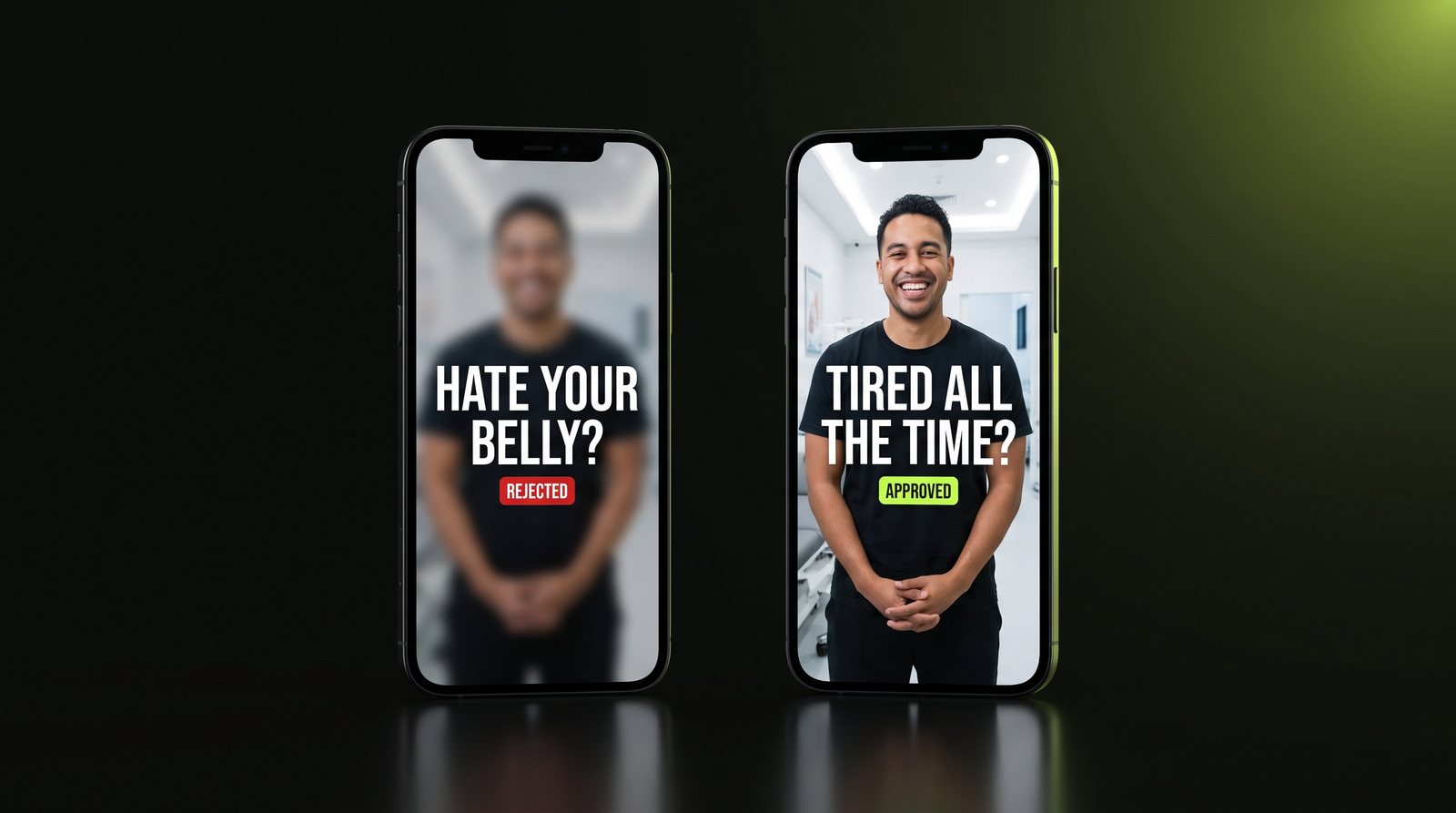
Talk about the visit, not his body.
The two phones show a weight loss ad, and the rule behind them, Meta's ban on copy that implies it knows the viewer's health, is the one TRT ads trip most. "Tired, gaining weight and losing your edge?" diagnoses the reader. "Testosterone testing and physician consults for men" describes the clinic.
Same clinic, same page. The approved line also keeps you clear of performance language, which Meta and TikTok both restrict. The phones are an illustration, not a client's account.
Every men's health post, read by a person.
No tool removes the compliance read. Every ad and page is read by a person against Google's drug list and what the account actually accepts, Meta's sexual health rules, FDA's labeling and your prescribing model, two rounds, before it runs. Testosterone is a prescription product, so that read is a drug-ad review, which is why a creator program for it adds $1,000 a month.
- ClaimsNo energy, libido or muscle promise tied to a drug. No aging cure.
- KeywordsService and place terms, submitted and read one by one. Hormone strings only where the account accepts them.
- PrescribingOnline prescribing only with LegitScript, in states where your prescribers are licensed.
- The pageThe landing page sells the consult and the labs, and lists the states you serve.


Newport Beach office. Clients anywhere.
Platform rules are national; prescriber licenses are state by state. For a clinic that prescribes online, Google's unauthorized pharmacies policy suspends the account without warning for targeting a location where it is not licensed. We launch in licensed states only. We run this from Newport Beach and work remote with men's health clinics across the United States.
Go deeper.
Get the account read first.
Fifteen minutes. Bring your keyword list and the ad that got rejected. We will tell you which strings Google is likely to refuse and what to bid on instead.
Asked by TRT and men's health clinics.
Can a TRT clinic run Google Ads?
Why did Google reject my TRT keywords?
How should men's health clinics target their ads?
Can we advertise ED treatment on Google?
Can our ads say testosterone treats low T from aging?
Can we prescribe TRT by telehealth and advertise it?
Can creators promote our TRT clinic on TikTok?
Sources, all read on September 26, 2026: Google Ads, Restricted drug terms, the prescription drug list, Sexual health and wellness, Health in personalized advertising and Unauthorized pharmacies; Meta Transparency Center, Health and Wellness (change log Jul 22, 2026), Drugs and Pharmaceuticals and Privacy Violations and Personal Attributes; TikTok Dangerous Products or Services (April 2025) and Branded Content Policy (effective August 31, 2026); FDA, Testosterone Information and the February 28, 2025 labeling alert; DEA release of December 31, 2025; 21 CFR 1308.13; PELORA Research Study 01 (September 23, 2026) and our published write-up of the September 15, 2026 refusal.